

CRM for Wholesale Trade: Dealers, Price Tiers and Large Orders
Note: the people and figures in this article are a composite example based on typical situations in small businesses in Uzbekistan.
Olim, based in Tashkent, imports household goods and everyday items from China and sells them wholesale to 140 shops and dealers across the regions. He once lost a 47 million UZS deal simply by forgetting about it — we covered that in "8 sales management mistakes". He then put his sales funnel in order and raised conversion from 12% to 22%. But wholesale has problems of its own: in ordinary sales the work ends with the deal, while in wholesale it only begins there.
One day Olim found out that one of his dealers in Fergana had owed 64 million UZS for 4 months. The manager who handled that dealer had quit, and the debt was left in his notebook. That same month, dealers in Namangan learned that their counterpart in Andijan had been given a lower price — and Olim had to give all of them an extra discount.
Olim ran the numbers: total dealer debt had reached 380 million UZS, and 30% of it was more than 60 days overdue. 35 of his 140 dealers hadn't ordered in a month and a half. And gross margin was 14% instead of the planned 18% — managers were giving discounts at their own discretion. In this article we use Olim's story to show how a CRM works for wholesale: a dealer database, price tiers, large orders, debt control and repeat orders.
5 hidden losses in wholesale trade
Wholesale business owners usually focus on products and prices. But money most often leaks out elsewhere:
- Pricing confusion — each manager gives their own discounts, and margin quietly melts away
- Uncontrolled debt — who owes how much and by when is scattered across notebooks and Excel
- "Dormant" dealers — a dealer who stops ordering isn't noticed in time
- Dealers leave with the manager — contacts and agreements live on one person's phone
- Disputes over large orders — price, deadlines and delivery terms stay verbal
In wholesale, profit isn't counted at the moment of sale but later — when the money arrives on time and the dealer orders again.
— Wholesale trade rule
1. A dealer database — every dealer in a digital card
In wholesale, a customer isn't a one-time buyer but a partner for years. That's why every dealer has a complete card in the CRM:
- Company and contact person — name, phone, Telegram, address and region
- Dealer tier — regular wholesale, dealer or major dealer
- Credit limit and payment terms — how much stock can be given on credit and within how many days it's paid
- Order history — what was bought, when and how much
- Order interval — for example, every 2 or 3 weeks
- Call and agreement history — who spoke with them, when and about what
Olim's 140 dealers used to be scattered across the Excel files and notebooks of 5 sales managers. They were imported into the CRM in a single day — now even if a manager leaves, the dealer stays with the company. For building a well-organized base, read "Building a customer base from scratch".
2. Price tiers — a clear rule for every dealer
In wholesale, the price isn't the same for everyone — and that's normal. The trouble starts when the price lives in each manager's head. Olim introduced 3 clear tiers:
- Regular wholesale — the base price for shops buying up to 10 million UZS a month
- Dealer — 10–40 million UZS a month: 7% off the base price
- Major dealer — over 40 million UZS a month: 12% off and 30-day payment terms
- Tiers are reviewed every quarter — when volume grows, the dealer moves up
- Discounts beyond the tier — only with the director's approval and a note in the CRM
Now every dealer's tier is visible on their CRM card: managers don't guess which price to quote, and when a dealer says "too expensive," they explain the next tier's terms instead of giving a discount. For handling price objections, read "Handling objections".
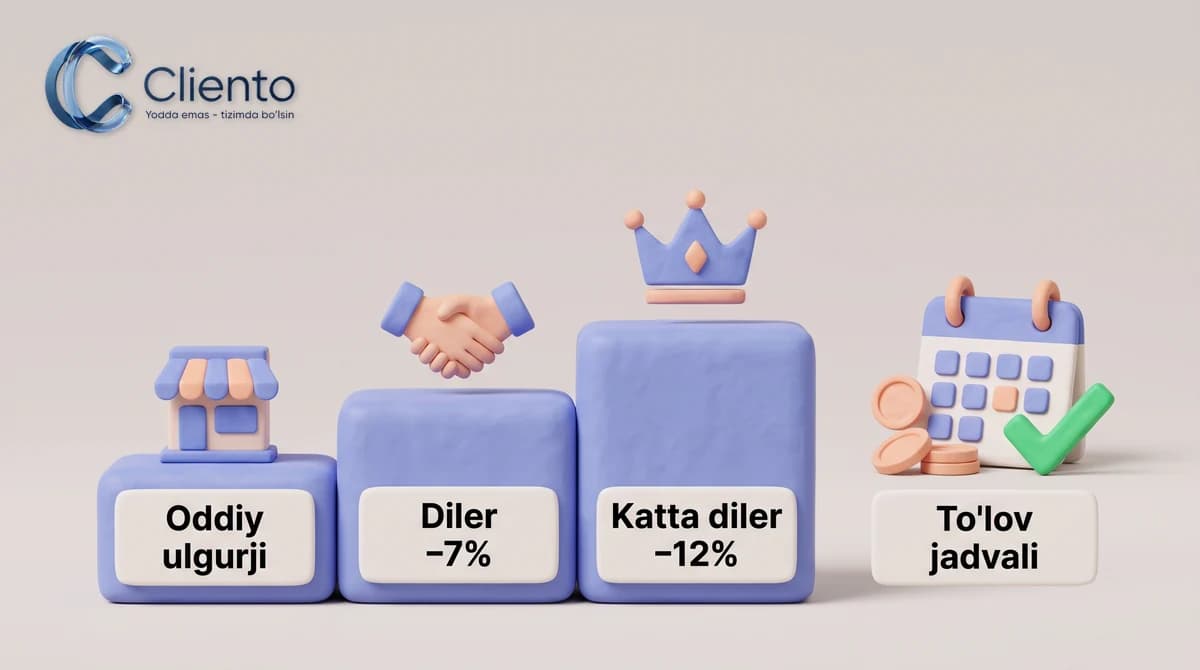
A price isn't a secret deal — it's a rule. Dealers talk to each other, so your pricing has to rest on a clear system.
— Price tier rule
3. Large orders — a deal managed stage by stage
In wholesale, a single order can be worth 50–200 million UZS and doesn't close in a day. Olim manages every large order in the CRM as a separate deal, following a B2B sales funnel:
- New request — the dealer says what they need, how much and by when
- Qualification — credit limit, old debt and payment discipline are checked
- Proposal — the tier price, delivery time and payment terms are sent
- Negotiation — volume, discount and installment payments are agreed
- Closed — a prepayment is taken, goods are shipped, remaining payments go into a schedule
Each deal has an assigned manager, and the agreed terms stay in the deal notes — verbal promises don't turn into disputes later. We covered raising conversion at each stage in detail in "Sales funnel optimization".
The most expensive thing in a large order is an unwritten term. If price, deadlines and payment terms aren't in the deal, each one becomes an argument later.
— Large order rule
4. Debt control — goods on credit aren't sold yet
In wholesale, goods are often given on credit. That's convenient for the dealer, but without control your working capital sits in other people's accounts. Olim manages debt through the payment schedule in the CRM:
- A payment schedule for every deal — amount, due date and the part already paid
- Partial payments — if the dealer pays in installments, the remaining debt is visible right away
- As a due date approaches, the assigned manager gets a Telegram notification
- Overdue payments stand out separately, and a notification comes for them too
- Credit limit rule — a dealer whose old debt exceeds the limit gets no new goods on credit
Now every Monday Olim looks at a single list: who owes how much and for how many days. The 64 million incident in Fergana never happened again — as soon as a payment is overdue, the assigned manager is notified and calls the same day.
Goods given on credit aren't sold yet. The sale ends only when the money is in the till.
— Debt control rule
5. Repeat orders and "dormant" dealers
The main income in wholesale comes not from new dealers but from regular orders by existing ones. That's why Olim tracks each dealer's ordering rhythm:
- Each dealer's usual order interval is recorded on their card
- When the next order is due, the manager gets a reminder
- Every month, dealers with no orders for more than 45 days are put on a separate list
- A "dormant" dealer gets a personal call to find out why: price, quality or a competitor
- When new products arrive, the dealers likely to be interested get the first offer
This brought an unexpected result: 23 of the 35 "dormant" dealers placed new orders. Most of them had simply been forgotten — nobody had called them. For making repeat contact systematic, read "Customer follow-up system".
Finding a new dealer takes dozens of calls. Bringing back an old one often takes just one.
— Repeat order rule
Olim's results
Eight months after moving his dealer base, price tiers, deals and payment schedules into the CRM, here's what changed in Olim's business:
- Share of overdue debt: 30% → 9%
- Total dealer debt: 380M → 210M UZS
- "Dormant" dealers: 35 → 12
- Average order: 18M → 23M UZS
- Gross margin: 14% → 17%
- Monthly turnover: 1.7B → 2.2B UZS
- Dealers lost when a manager leaves: none anymore — everything is in the CRM
I used to sell goods and then wait for the money. Now I see on one screen how much each dealer took, how much they owe and when they'll pay — and the money arrives on time.
— Olim, wholesale business owner
What a CRM for wholesale should include
Wholesale is more complex than ordinary retail: it involves long relationships, credit and large amounts. A CRM should include:
- Dealer database — contacts, region and the history of all communication
- Custom fields — dealer tier, credit limit, payment terms, order interval
- Deals and a B2B sales funnel — large orders stage by stage
- Payment schedule — partial payments, due dates and remaining debt
- Reminders and notifications — for due dates and the next order
- Excel import and export — to move an existing base quickly
- Reports — by manager, deal and payment
Cliento has all of this: client cards and custom fields, a deal pipeline, deals in UZS or US dollars, payment schedules and partial payments, Telegram notifications about upcoming and overdue payments, reminders, and Excel import and export. Pricing starts at 150,000 UZS per month. For CRM selection criteria, read "How to choose a CRM system for your business".
How to get started — practical steps
You don't need a big IT department to bring order to wholesale. Olim started with these same 7 steps:
- Gather all dealers from managers' Excel files and notebooks into one database
- Turn price tiers into a clear rule — with volume thresholds and discount percentages
- Assign each dealer a tier, credit limit and payment terms
- Enter all open debts into the CRM with a payment schedule
- Run large orders as deals, stage by stage
- Set reminders based on each dealer's order interval
- Review the debt list every week and "dormant" dealers every month
For the difference between Excel and a CRM, read "CRM or Excel: which is better", and for how the investment pays off, read "CRM investment: calculating ROI".
Frequently asked questions
Does a small wholesale business need a CRM?
Yes. Even with 20–30 regular dealers, it's hard to keep debts and repeat orders in your head. In wholesale, a CRM's value is measured not by the number of dealers but by credit and repeat orders.
Should every dealer get an individual price?
Usually not — 3–4 clear tiers are enough. Individual prices for every dealer tangle up agreements and cause resentment among dealers. Exceptions are approved by the director and recorded in the CRM with a note.
Does a CRM track warehouse stock?
No. A CRM is for dealers, deals and payments. Warehouse stock and accounting need separate software. The two complement each other: inventory software shows what's in the warehouse, while the CRM shows who buys what, when and how much.
How can I reduce the risk of selling on credit?
Give every dealer a credit limit and payment terms, and don't ship on credit to anyone whose old debt exceeds the limit. For large orders, take a prepayment and put the rest into a clear payment schedule.
What if my prices are in US dollars?
No problem. In Cliento, each deal amount can be kept in UZS or US dollars. The key is to record the currency and the exchange-rate agreement clearly in each deal, so there are no disputes at payment time.
Will I lose contact with dealers if a manager quits?
Not if all dealers, calls and agreements are stored in the CRM rather than on the manager's personal phone. When a manager leaves, their open deals are reassigned to another manager, and the dealer stays with the company along with their full history.
Conclusion
Success in wholesale isn't only about selling a lot — it's about selling at the right price, collecting the money on time and bringing dealers back again and again. Olim brought his dealer base, price tiers, large orders and debts into one system. As a result, the share of overdue debt fell from 30% to 9%, and monthly turnover grew from 1.7 to 2.2 billion UZS.
A relationship with a dealer lasts for years — it can't be kept in one manager's memory or notebook. "Not in memory — in the system."
Start organizing your wholesale business today. Sign up at crmcha.uz in 2 minutes and try Cliento in free demo mode — import your dealers from Excel and build your first payment schedule that same day.