
Customer follow-up: the right system and timing for repeat contact
Note: the people and figures in this article are a composite example based on typical situations in small businesses in Uzbekistan.
Aziza runs an online cosmetics store. In article 22 we saw how she raised conversion from 15% to 34% using ready sales scripts. But a problem remained: customers left with "I'll think about it," "I'll write later" — and many never returned. Aziza would message once and, getting no reply, stop. "So as not to bother them."
One day she saw a simple statistic and was stunned: about 80% of sales happen after 5-12 contacts. But most sellers stop after the first or second try. That means most customers were ready to buy right after the point where you gave up. Aziza was losing exactly these "golden" customers every day.
The solution is follow-up — a repeat-contact system. It's not "bothering" — it's helping the customer and reminding them on time. Using Aziza's example, we'll cover why follow-up is the heart of sales, when and how many times to reach out, what to say, and how to automate it in CRM.
Why the first "no" isn't the end
Many don't grasp one truth: a customer's "no" often means "not now." They're busy, undecided, budget comes later. It's not rejection — it's timing. What the numbers say:
- ~80% of sales happen after 5-12 contacts
- But ~90% of sellers make fewer than 4 contacts
- So most stop before the point where sales begin
- One "no" isn't "never" — it's "not yet"
It's pure math: if you reach out twice and a competitor seven times, the customer buys from whoever reminded them on time. More — in "8 sales management mistakes".
A customer's "no" often means "not now." Whoever reminds them patiently and on time gets the sale.
— Follow-up rule
The follow-up schedule — when and how many times
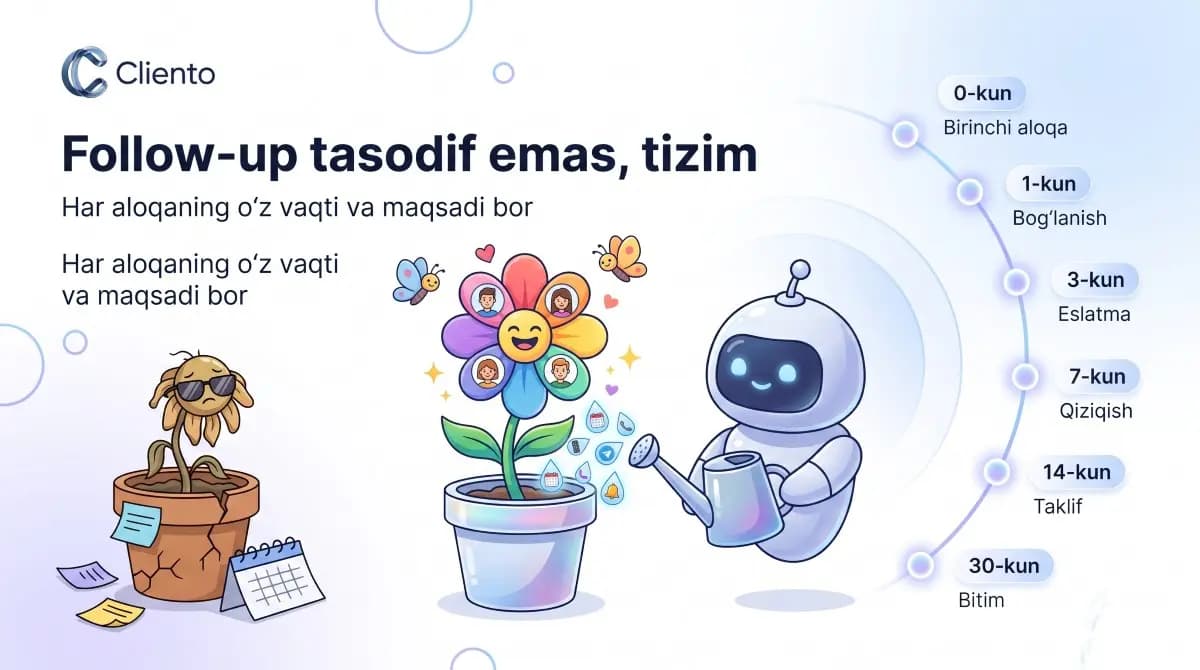
Follow-up isn't random — it's a system. Each contact has its time and purpose. Aziza introduced this schedule (after "I'll think about it"):
- Day 0: first contact — reply within 5 minutes
- Day 1: first follow-up — "did you find your answer? need help?"
- Day 3: give value — a useful tip, extra info, or a sample
- Day 7: give trust — a review, another customer's result, a best-seller
- Day 14: reminder with an offer — a limited promo or discount
- Day 30: final nudge — "shall we place the order or remind you later?"
After day 30 don't stop — move the customer to a long-term list (monthly useful content or a promo).
90% of sellers make fewer than 4 contacts. So whoever reaches the 5th attempt is already ahead of 90% of competitors.
— Persistence rule
What to say at each contact — don't repeat yourself
The biggest mistake is repeating the same thing: "Hello, did you buy?", "Did you buy?". It annoys. Each contact must serve a purpose:
- Offer of help — "any questions, how can I help?"
- Value — a useful tip on using the product
- Social proof — reviews and others' results
- A new reason — a new product, seasonal offer, promo
- A soft close — "if now isn't the time, tell me when to remind you"
Give value at each contact — then follow-up isn't annoying, it looks like care. Ready texts — in "Sales scripts and templates".
Bad follow-up: repeating "did you buy?". Good follow-up: giving the customer new value each time. The first annoys, the second sells.
— Repeat contact rule
Follow-up channels — call, Telegram, message
Follow-up isn't only calling. In Uzbekistan the most effective channel is Telegram: a customer may not answer a call but will read a message. Mix channels:
- First contact — a call or the channel the customer wrote from
- Later follow-ups — mostly Telegram
- At a key stage — a call
- Mass reminders — automatic via a Telegram bot
More — "Telegram business and automation".
Automatic follow-up — CRM reminds you
The biggest problem with follow-up is keeping it in your head. With 100 customers it's impossible to remember who, when, and which contact number. This is where CRM decides:
- A follow-up date is set for each lead — CRM reminds you on time
- Auto-messages — day 1, 3, 7 follow-ups go via Telegram automatically
- No customer is forgotten — the system tracks each one
- Follow-up history is saved
- Seller performance is visible — who follows up, who doesn't
It's the only way to turn follow-up into a system. Other methods — "10 sales automation methods". Follow-up fixes exactly the funnel stage where the most customers are lost — "Sales funnel optimization".
Follow-up can't be kept in your head — it must be systematized. Not in memory — in the system: then no customer is lost.
— Automation rule
Follow-up works in every industry
Follow-up isn't only for online sales. It's the customer-return mechanism in any business:
- Auto service — oil-change and maintenance reminders: "CRM for auto service"
- Dental clinic — prevention and next-visit reminders: "CRM for dental and medical clinics"
- Restaurant — bringing a regular back with a greeting and an offer: "CRM for restaurants and cafes"
- The principle is the same everywhere: on time, with value, systematically
The general retention strategy — "Customer retention strategies".
5 biggest follow-up mistakes
- One contact and stop — the costliest mistake
- Repeating the same thing — "did you buy?" annoys
- Too often or too rarely — you need a schedule
- Only selling — no value, just "buy it"
- Keeping follow-up in your head — many customers get forgotten
All are solved by one thing: systematic and automatic follow-up.
Follow-up isn't a sale — it's a relationship. And a relationship isn't built on one message; it's built with time and consistency.
— Relationship rule
Aziza's results
- Sales from "I'll think about it": 10% → 32%
- Repeat buyers' share: 22% → 45%
- Average contacts: 1.3 → 6
- ~20% of non-responding leads returned
- Overall monthly sales: +38% (with no ad spend)
I used to message once and stop — "so as not to bother them." In reality I just wasn't helping the customer. Now the system reminds me of each on time — and customers are grateful for the care.
— Aziza, online cosmetics store owner
How to start
- Register at crmcha.uz in 2 minutes, free demo
- Set your follow-up schedule — days 0, 1, 3, 7, 14, 30
- Write text for each stage — non-repetitive, valuable
- Set up auto-messages via Telegram
- Enable a follow-up reminder for each lead
- Measure results after a month — returned customers and conversion
CRM payback — in "CRM investment: ROI calculation".
Frequently asked questions
Isn't follow-up annoying?
No, if done right. Annoying is writing "did you buy?" every day. Proper follow-up is on time, with value, helping the customer.
How many times to reach out?
At least 5-7 if the customer hasn't said a clear "no." 80% of sales happen after 5-12 contacts. Each contact should give different value.
At what intervals?
More often at first (days 1, 3, 7), then less (14, 30), then long-term (monthly).
How to automate follow-up?
Through CRM. A date is set for each lead; the system reminds you and sends some messages via Telegram itself.
Does a small business need follow-up?
Yes, especially. Every customer is expensive — you can't lose any. Follow-up is the cheapest way to raise sales.
What if the customer doesn't reply?
Change the channel (Telegram instead of a call), change the message (new value), and continue. After several tries — move to a long-term list, don't delete entirely.
Conclusion
Follow-up is the most underrated yet most effective sales tool. Most stop after the first "no," but 80% of sales happen after 5-12 contacts. The secret is systematic, valuable repeat contact — knowing when, how, and how many times to reach out.
Aziza proved it: the same customers, the same ads, but with a follow-up system her sales grew 38%. The difference was not stopping after one message but reminding systematically. "Not in memory — in the system" — let your follow-up be in the system too.
The first step — try Cliento CRM free at crmcha.uz in 2 minutes.
Also read
Sales scripts and templates: ready-made texts for every customer type
First contact, follow-up, objections, and closing — ready sales texts for every situation. Practical scripts for WhatsApp, Telegram, and calls.
Sales automation: 10 ways to stop doing manual work
70% of your salespeople's time goes to manual tasks. Automation eliminates this waste — 10 practical methods and 3x efficiency growth with CRM.
Sales funnel optimization: how to raise conversion at every stage
Sales funnel optimization: where customers drop off, how to find the bottleneck, raise conversion at each stage, and confirm it with an A/B test.


