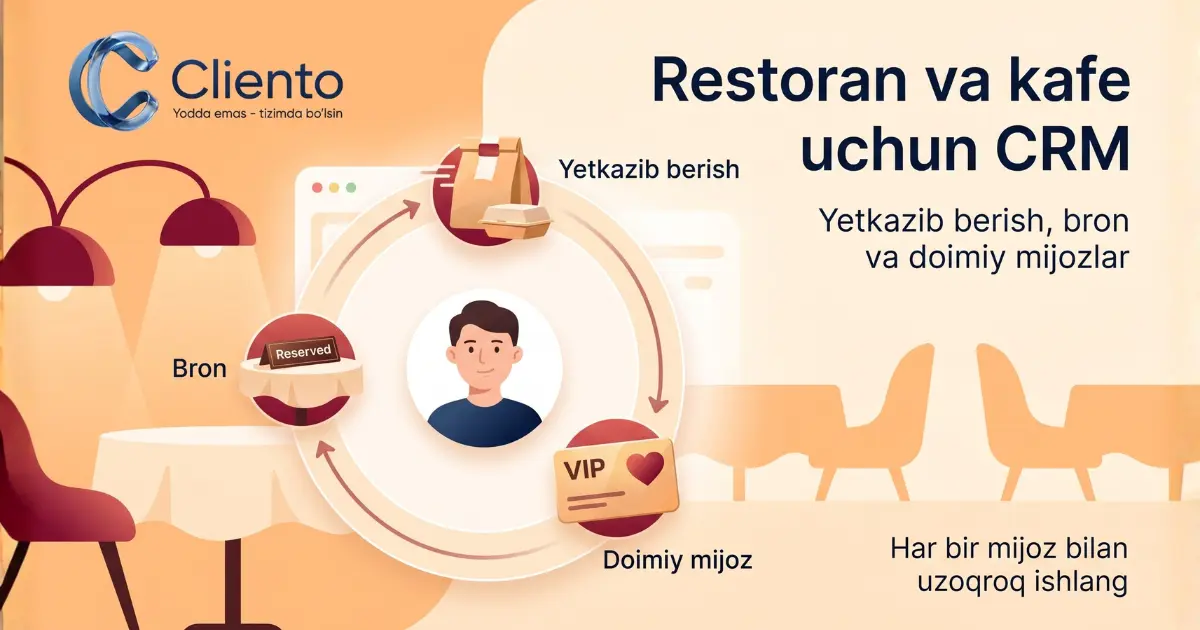
CRM for restaurants and cafes: delivery, reservations, and repeat customers
Note: the people and figures in this article are a composite example based on typical situations in small businesses in Uzbekistan.
In article 18 we saw how Akmal pulled his restaurant from an 8M UZS loss to 22M UZS monthly profit using KPIs and reporting. The business got on its feet. But Akmal didn't stop — a new question arose: how to grow further?
The answer was in three directions: delivery, table reservations, and repeat customers. But everything was scattered: delivery orders came via Telegram, Instagram, and calls in separate notebooks; reservations lived in the waiter's memory; regulars were known "by face," but their name, taste, and last order were stored nowhere. The restaurant was full, but there was no customer base.
This is exactly where CRM takes a restaurant to the next level. Using Akmal's example, we'll cover delivery, reservations, the loyalty program, menu analysis, and restaurant KPIs.
5 invisible holes in the restaurant business
- Delivery orders scattered — Telegram, Instagram, calls; no customer history
- Reservations uncontrolled — who booked for how many lives in the waiter's memory; many no-shows
- The regular isn't recognized — name, taste, birthday not stored
- The menu isn't analyzed — which dish is profitable, which loses money
- Marketing is blind — ad money is spent, but customer return isn't measured
A restaurant can be full, but if the customer base is empty, it's not a business — it's luck. And luck doesn't repeat every day.
— Restaurant business rule
1. Delivery orders — with each customer's history
Delivery is a big revenue source but the most chaotic part. CRM gathers orders from all channels into one place and remembers every customer:
- Orders from Telegram, Instagram, and calls in one system
- Each customer's address, phone, and order history
- On a repeat call, name, last order, and address appear instantly
- The most active customers stand out — special attention
- Delivery time and courier status tracked
Now Akmal knows what "the usual" means — the history is visible. More on the base — "Building a customer base from scratch".
2. Table reservations and the no-show problem
Reservations are both convenience and a headache. The biggest problem is no-show: booking and not coming. On holidays it's costly: the table is taken but there's no revenue. CRM brings order:
- Every reservation in the system — date, time, party size, special requests
- Auto-confirmation and reminder to the customer via Telegram
- Regulars' favorite table and tastes saved
- No-show statistics — who often doesn't show
- Freed tables quickly offered to others
A reminder sharply reduces no-shows. The reservation-and-reminder principle is detailed in "CRM for beauty salons and SPA: booking and client history"; it works the same for restaurants.
A no-show isn't a lost table — it's lost revenue. One reminder brings that revenue back.
— Reservation management rule
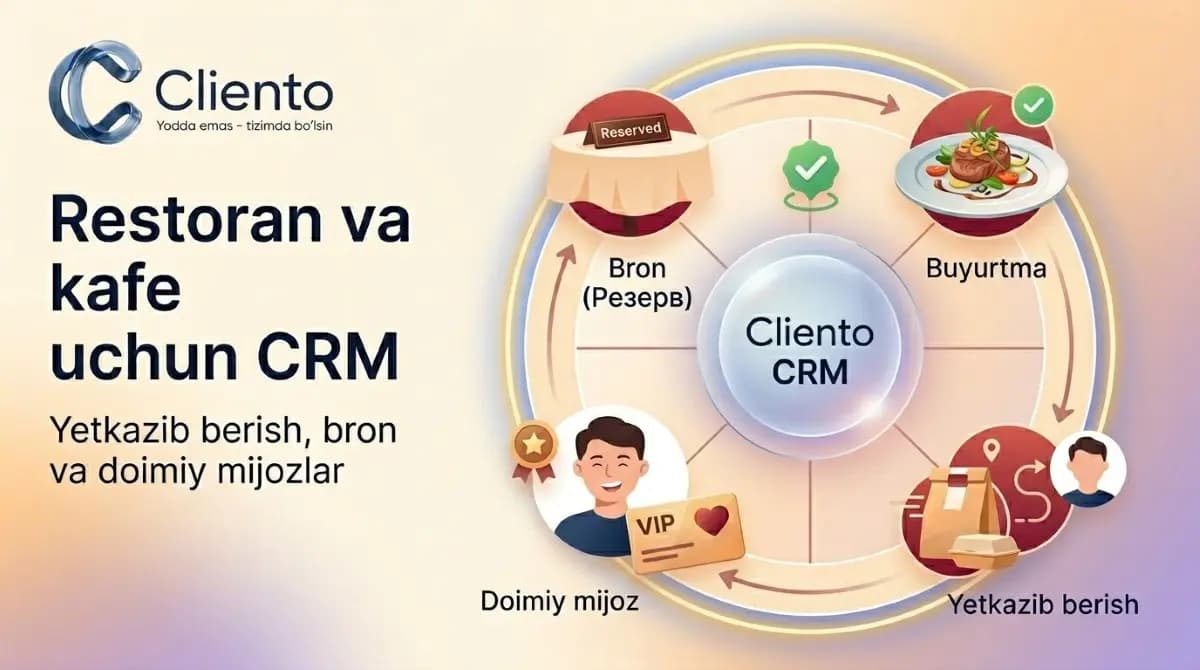
3. Loyalty program — the heart of restaurant profit
Real restaurant profit comes from repeat customers. A one-time guest is one-time revenue; a weekly guest is a big yearly sum. Keeping a regular is cheaper than finding a new one, but many don't do it. CRM builds a loyalty program:
- Each customer's name, taste, and order history
- Birthday and holiday greetings — with a gift or discount
- Bonus points for orders
- Win back long-absent customers — a "we missed you" offer
- Post-visit survey — quality control
Full strategy — "Customer retention strategies". On automating greetings — "Telegram business and automation".
What fills a restaurant isn't a new guest but the one who returns. A regular is also your best advertisement.
— Repeat customer rule
4. Menu analysis — which dish brings more profit
Not every dish brings the same profit. Some sell a lot but have low margin; others sell little but have high margin. CRM and sales reports show the exact picture:
- Which dishes are ordered most
- Which bring the most net profit
- What sells at which time of day
- Remove low-selling and loss-making dishes
- Waiters actively recommend the most profitable dishes
Every dish on the menu takes a work spot — if it doesn't bring profit, let it yield the spot to one that does.
— Menu engineering rule
Akmal removed 6 low-profit dishes and put the 10 most profitable into waiter recommendations — the average check grew.
5. Restaurant KPIs — managing by numbers
KPIs are exactly what saved Akmal's restaurant. Key metrics:
- Average check
- Share of repeat customers
- Table turnover
- No-show rate
- Number and average check of delivery
- Most profitable dishes and their share
What you don't measure, you can't manage. Detailed — in "Business KPI and reporting system", featuring Akmal.
Akmal's new results
- Repeat customers: 20% → 45%
- Reservation no-show: 30% → 8%
- Delivery orders: 400 → 850/month
- Delivery average check: 85K → 110K UZS
- Dine-in average check: +15% thanks to menu analysis
- Marketing is measurable — you see which offer brings a customer back
Before, my restaurant was full but I didn't know my customers. Now I know the name, taste, and birthday of every regular. They're not guests anymore — they're family.
— Akmal, restaurant owner
What a CRM for restaurants and cafes should have
- Delivery orders from all channels in one place
- Table reservations and auto-reminders
- Customer card — name, taste, history
- Loyalty program — points, discounts, greetings
- Menu and sales reports
- Telegram integration
Cliento CRM is built for Uzbekistan: Uzbek interface, full Telegram integration (bot and Mini App), local payments (Payme, Click, Uzum), from 150K UZS/month. See "How to choose a CRM for your business".
How to start
- Register at crmcha.uz in 2 minutes, free demo
- Add your regulars — name, phone, tastes
- Connect delivery channels (Telegram, Instagram, calls)
- Set up reservations and auto-reminders
- Enable the loyalty program — points and greetings
- Analyze reports after a month
CRM payback — in "CRM investment: ROI calculation".
Frequently asked questions
Does a small cafe need CRM?
Yes. For a small cafe, every regular matters. Remembering a taste and sending a birthday greeting is the cheapest, strongest marketing.
Will waiters and cooks learn the program?
Everything runs through Telegram — see an order, confirm a reservation, open a customer's history in a couple of taps.
How do I manage delivery orders?
Orders from Telegram, Instagram, and calls gather in one system. Address and history are saved; courier status is tracked.
How to reduce no-shows?
With an auto-reminder before the reservation. The customer often just forgets — a reminder brings them back.
How does the loyalty program work?
Points accumulate; on birthdays and holidays an auto-greeting and offer go out. Long-absent customers get a special offer.
How much and does it pay off?
From 150K UZS/month. If even a few regulars return or no-shows drop, the system pays off many times over.
Conclusion
A restaurant's and cafe's success depends not only on food quality but on the customer-return system. Delivery, reservations, loyalty, and menu analysis — all in one CRM. Akmal proved it: first he saved the restaurant with KPIs, then grew it with a repeat-customer system.
Most importantly — customers are no longer just passing guests but a base of regulars with names and tastes. Cliento's motto says it: "Not in memory — in the system."
The first step — try Cliento CRM free. Register at crmcha.uz in 2 minutes.