

CRM for a real estate agency: properties, clients, and deals
Note: the people and figures in this article are a composite example based on typical situations in small businesses in Uzbekistan.
Farrux runs a real estate agency in Tashkent. He has 6 agents, knows the market well, and has a solid reputation. But the agency's internal work was chaotic. Properties were wherever someone had written them down: one in Excel, another in a notebook, a third in an agent's phone gallery. Buyer requirements weren't recorded anywhere at all — they lived in the agents' memory.
The same scene repeated daily: a buyer calls and says "Yunusabad, 3 rooms, up to 500 million." The agent posts in the group chat: "Do we have such a property?" Someone answers, someone doesn't. Half an hour later it turns out a matching property did exist — but another agent knew about it and was busy that day. The buyer doesn't wait; they call another agency.
Farrux did the math: about 120 buyers contact the agency each month, but only 15 reach a deal. The problem wasn't the properties or the agents — there was no system holding properties and buyers together and connecting them. Using Farrux's example, we'll look at how CRM works for a real estate agency.
5 invisible losses in real estate
- The property base is scattered — Excel, notebook, and phone gallery; no shared view
- Buyer requirements aren't recorded — what they want is known to one agent only
- The matching property isn't found — the base exists, the buyer exists, but nothing connects them
- Viewings are tangled — who showed which property and when isn't tracked
- Long deals get forgotten — a real estate deal runs 2-6 months and is lost without tracking
The costliest loss in real estate is having the right property in your base and failing to offer it to the buyer.
— Matching rule
1. Property database — every property in a digital card
In CRM each property — an apartment, a house, or a land plot — is a separate card. Farrux's whole agency now works from one base:
- Property type and location — district, street, landmark
- Key parameters — number of rooms, area, floor, condition, renovation level
- Price and negotiation limit — how much the seller will come down
- Photos and documents — in one place, visible to every agent
- Property status — active, taken, reserved, or sold
- Responsible agent and property history — who brought it, how many viewings
Now a property lives in the agency's base, not one person's phone. An agent goes on holiday and the property isn't lost. On building a base — "Building a customer base from scratch".
2. A two-sided client base — seller and buyer
Real estate differs from other fields in one important way: there are two kinds of client, and you need both. The seller supplies the property, the buyer brings the money. CRM keeps both:
- Seller card — what property they have, what price they expect, how urgent it is
- Buyer card — what they're looking for: district, rooms, budget, floor preferences
- Buyer's budget and payment method — cash, mortgage, or installments
- Communication history with both — when you spoke, what was agreed
- Source — where the buyer came from: a listings site, a referral, or social media
Writing down the buyer's requirement is the most valuable habit in real estate. There may be no match today, but tomorrow one arrives — and you'll remember that buyer instantly.
An agent who doesn't record a buyer's requirement forgets it within two weeks. One who records it calls first the moment the right property appears.
— Recording the requirement rule
3. Matching buyers to properties — the heart of the agency
This is the strongest capability of a real estate CRM. When both the properties and the buyer requirements sit in one system, connecting them takes seconds:
- Filter by the buyer's requirement — district, rooms, budget, floor
- A list of matching properties appears in seconds — no need to ask in a chat
- When a new property comes in, the agent reviews saved buyer requirements and quickly finds matching buyers
- The agent calls right away: "The option you were looking for has come up"
- Price-reduced properties — re-offer to buyers who passed because of price
This function made the biggest difference in Farrux's agency. Finding a match used to take half an hour and five people's time. Now one agent sees it on screen and answers while the buyer is still on the line.
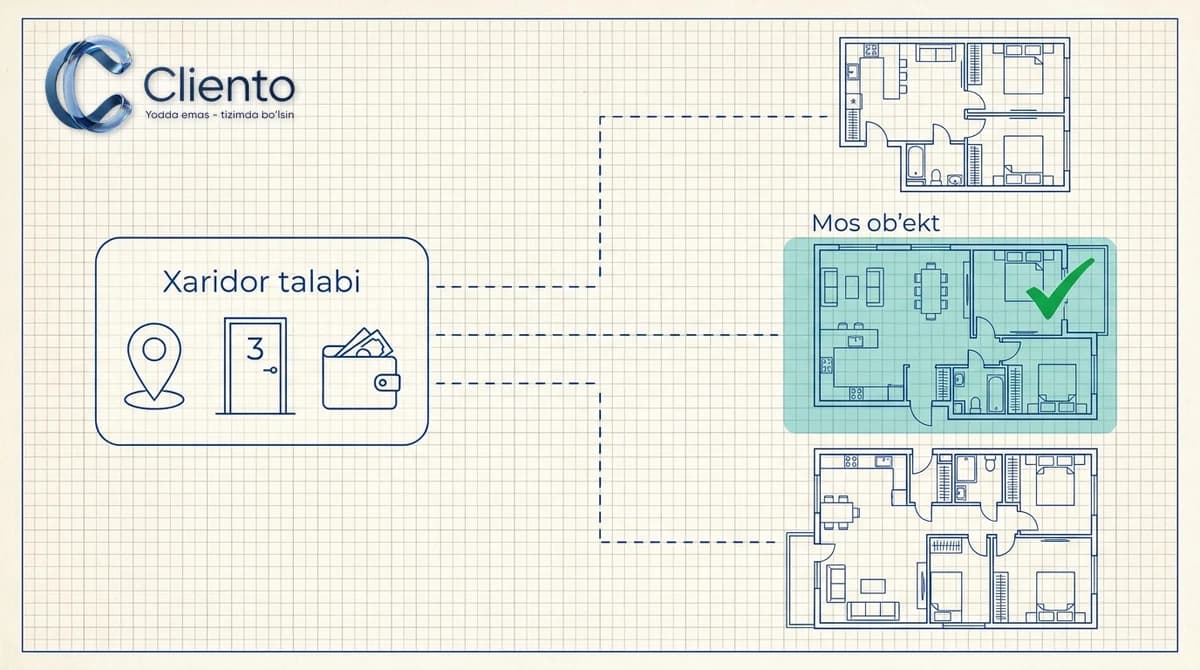
In real estate, speed decides. Whoever offers the right option first gets the deal.
— Speed rule
4. Viewing schedules and agents' work
A viewing is the core stage of a real estate sale. One deal can take 5-10 viewings. CRM brings order:
- Every viewing goes on the schedule — date, time, property, buyer, agent
- Before a viewing, the agent gets a Telegram reminder — then calls the buyer and seller to confirm the time
- The outcome is recorded after — what they liked, what they didn't, the next step
- Statistics per property — how many viewings, why it isn't selling
- Agent load and performance — who shows more, who closes more
"Why isn't this property selling?" now has a precise answer: 12 viewings, and most found the price high. That's the basis for a price conversation with the seller. The booking-and-schedule principle is also shown in "CRM for beauty salons and SPA".
5. Tracking long deals to the end
A real estate deal doesn't close in a day — it runs 2 to 6 months through many stages. That length is exactly why deals get lost. CRM holds the deal stage by stage:
- Deal stages — interest, viewing, negotiation, deposit, documents, registration
- At each stage — a responsible agent and the next step
- Reminders during the documents stage — no deadline is missed
- Deals that have gone quiet stand out — the agent returns to them
- Reasons for not closing are recorded — price, documents, or financing
On tracking long deals and raising conversion at each stage — "Sales funnel optimization"; on the repeat-contact system — "Customer follow-up".
A property deal doesn't close in a day. So hold it in a system, not in your memory — over 6 months human memory isn't reliable.
— Long deal rule
Where leads come from and how to collect them
Buyers arrive from several channels: listing sites (OLX, for example), Telegram channels, Instagram, referrals, and direct calls. The problem is that each channel stays separate. CRM merges them into one flow:
- Enquiries from all channels land in one list
- The source is stored for each lead — you see which channel produces deals
- No enquiry is left unanswered — each has an owner
- The ad budget goes to the channel that works
To learn which channel brings more clients, see "15 ways to attract clients via Instagram and Telegram".
Farrux's results
- Deals closed per month: 15 → 26
- Time to find a matching property: ~30 minutes → seconds
- Unanswered buyer enquiries: nearly to zero
- Property base: 200 → 480 (all in one system, nothing lost)
- Losing properties and clients when an agent leaves has stopped
- Half the long deals used to slip out of sight — now all are tracked
Each of my agents used to run their own mini-agency: their properties, their clients, their notebook. Now there is one agency. Whoever answers the buyer's call, the answer is the same and it's fast.
— Farrux, real estate agency owner
What a real estate CRM should have
- Property database — parameters, photos, status, and price history
- Buyer requirements — district, budget, rooms
- Matching and filtering — find properties for a request quickly
- Viewing schedule and auto-reminders
- Stage-by-stage tracking of long deals (a funnel)
- Lead collection from all channels with source tracking
- Telegram integration — mobile work for agents and reminders
Cliento CRM is built for Uzbekistan: Uzbek interface, flexible custom fields (for property parameters), full Telegram integration, local payments (Payme, Click, Uzum), from 150K UZS/month. See "How to choose a CRM for your business".
How to start
- Register at crmcha.uz in 2 minutes, free demo
- Gather every agent's properties into one base
- Set up property parameter fields — district, rooms, area, floor, price
- Record every new buyer's requirement — this is the most valuable base
- Turn on the viewing schedule and reminders
- Configure deal stages and measure the result after a month
CRM payback — in "CRM investment: ROI calculation".
Frequently asked questions
Does a small agency need CRM?
Yes. Even with 2-3 agents, a shared base of properties and requirements speeds up matching. It helps a solo agent too — buyer requirements aren't forgotten.
What if agents don't want to add their properties?
This resistance is common. The fix is keeping the responsible agent on the card and making commission splits transparent. The agent doesn't lose the property — they sell it faster through a colleague's buyer.
Can I store property photos and documents?
Files aren't uploaded to the Cliento card itself, but you can save a link to the photos and documents (for example, a Telegram channel post or a cloud folder) in a custom field or note. That way an agent heading to a viewing opens everything from their phone in one tap.
How do I track long deals?
Split the deal into stages (interest, viewing, negotiation, documents, closing) and set a next-step date for each. CRM reminds you — even a 6-month deal isn't lost.
How do I collect enquiries from listing sites?
Enter each enquiry in CRM with its source (from OLX, from Telegram, by referral). After a month you'll see clearly which channel produces real deals.
How much and does it pay off?
From 150K UZS/month. In real estate, the commission on a single extra deal covers the system for years ahead.
Conclusion
A real estate agency's success depends not on the number of properties but on the ability to connect a property and a buyer quickly. A property database, seller and buyer cards, matching, viewing schedules, and long-deal tracking — all in one CRM. Farrux proved it: the same agents, the same market, but deals went from 15 to 26 a month.
Most importantly — neither the property nor the buyer lives in one person's phone anymore; both are in the whole agency's system. Cliento's motto says it: "Not in memory — in the system."
The first step — try Cliento CRM free at crmcha.uz in 2 minutes.