Building a customer base from scratch: where to find your first 100 customers
Note: the people and figures in this article are a composite example based on typical situations in small businesses in Uzbekistan.
Jasur is an excellent carpenter. After 10 years in someone else's workshop, he finally opened his own furniture business. Great product, lower prices than competitors. But the first month brought only 2 orders — both from relatives. Second month — 1 order. "Why no customers?" he didn't understand. By the end of month three, money ran out. Then he realized a bitter truth: creating a great product isn't even half of business. The main challenge is finding customers. And he had no idea how to do it.
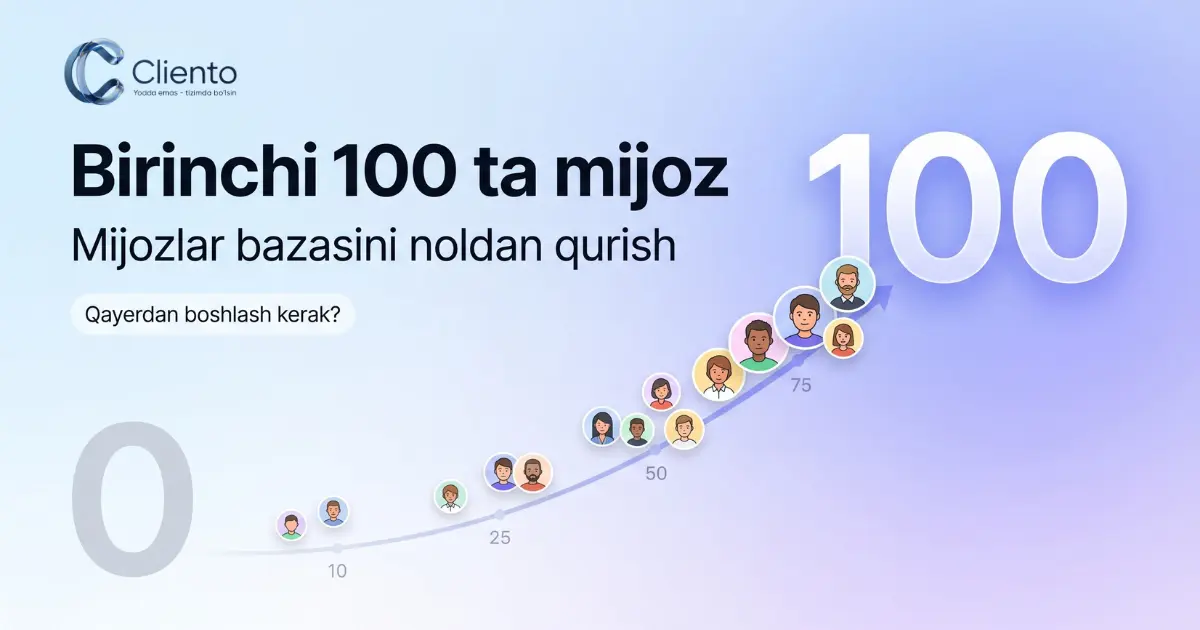
This is familiar to almost every new entrepreneur. You can be a master of your product, but finding customers is a completely different skill. And the hardest part — the first 100 customers. Cross that threshold and the business starts moving on its own. In this article, we break down how to gather your first 100 customers from scratch — step by step, the real path Jasur took.
Why the first 100 customers are the hardest and most important
- In a new business nobody knows you — trust is zero
- No referrals — first customers fear being "test subjects"
- Empty portfolio — nothing to show
- No marketing experience — you don't know which channel works
- Limited budget — no money for big advertising
The first 100 customers aren't about money — they're about foundation. They become your referrers and the seed of your future 1000 customers.
— Business foundation rule
First step: run a CRM from your first customer
The biggest mistake is thinking "few customers now, I'll set up CRM later." The opposite is true: track from the first customer. Information about each customer is gold: who came, what they asked, how much they paid, who referred them. This is your future wealth.
What CRM is — in "What is CRM — complete guide". How to choose CRM — in "How to choose CRM for your business".
Stage 1 (1-10 customers): Warm network
First customers come not from ads but from people who already know you: relatives, friends, former colleagues, neighbors. They trust you personally.
- Review your phone contacts — who might need your product
- Write a personal message (not mass)
- Announce on social media — on your personal page
- Give first customers a special price — "opening discount"
- Most important: do every job perfectly — this is your first portfolio
Jasur found his first 8 customers this way — all through acquaintances. He made each piece perfectly, photographed it, asked for a review. These photos and reviews became his weapon in the next stage.
The warm network isn't something to be shy about. Every successful business got its first customer from an acquaintance. Don't hesitate — offer.
— Starting rule
Stage 2 (10-30 customers): Referrals
If your first 10 customers are happy — they become your strongest channel. A referred customer is the highest quality: already trusts you, asks little about price, decides quickly. But referrals don't come on their own — you must ask.
- After the job, ask: "I'd be glad if you recommend me to acquaintances"
- Introduce a referral program: "Bring a friend — both get 10% off"
- Ask for a review — publish on social media
- Mark each referral in CRM — who brought whom
- Thank the referrer — a small gift or personal gratitude
After launching a referral program, Jasur got 18 new customers in 2 months. Now he tracked in CRM who brought whom and knew his most active referrers.
Stage 3 (30-60 customers): Organic content
Now you have a portfolio, reviews, experience. Time to reach a wide audience — but still free, organically.
- Open an Instagram business profile — post each job with quality photos
- Make Reels — the making process, "before-after" videos
- Open a Telegram channel — products, prices, reviews
- Give useful content — "how to choose furniture"
- In each post — a clear action: "Message to order" + contact
Full 15 ways to attract via Instagram and Telegram — in "15 ways to attract via Instagram and Telegram". Which channel to choose — in "WhatsApp vs Telegram vs Instagram".
Important: enter every Instagram and Telegram inquiry into CRM as a lead. Otherwise, with a flow of inquiries, everything gets confused. How to convert leads — in "Converting leads to clients".
Organic content is a tree that bears fruit for years. A video posted today brings a customer tomorrow and a month from now.
— Content marketing rule
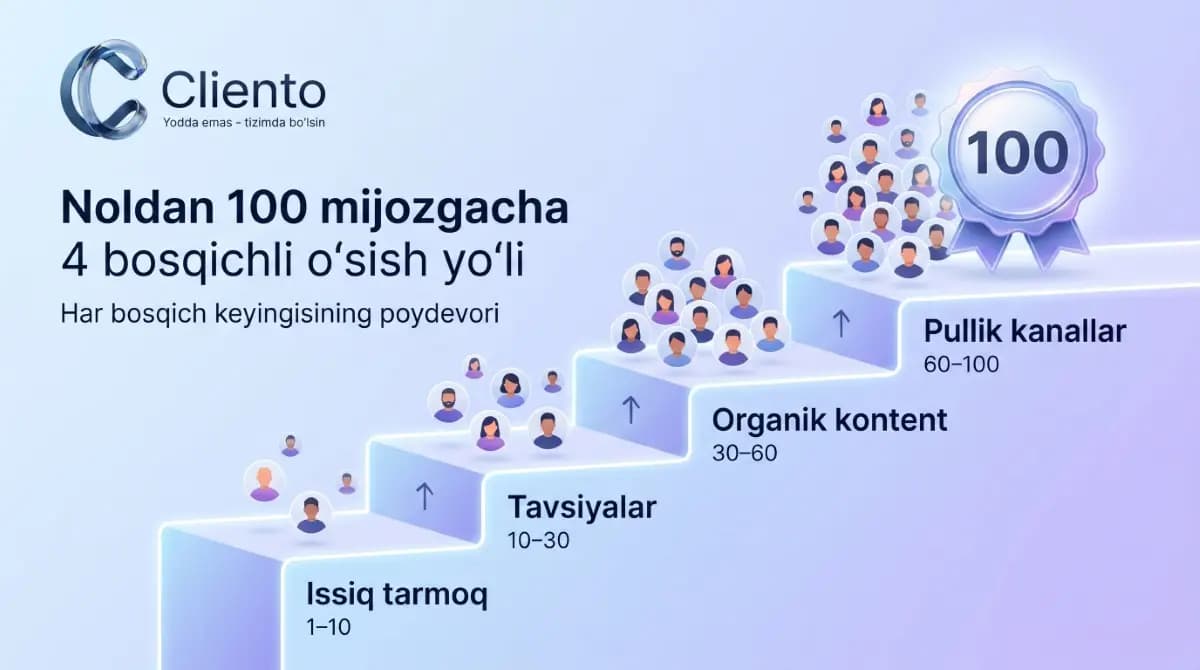
Stage 4 (60-100 customers): Paid channels and systematization
Now you have everything: portfolio, referrals, organic presence. And most importantly — you know where customers come from (thanks to CRM). Now paid advertising is safe — you can calculate ROI.
- Instagram Ads — promote your best posts
- Telegram channel ads — find a channel in your niche
- OLX listings — great for furniture
- Track each channel's ROI in CRM
- Turn off the non-working channel, increase budget on the working one
CRM payback — in "Does CRM investment pay off?".
How to manage your first 100 customers
- Customer card — name, phone, address, source
- Order history — what, when, how much
- Referral chain — who brought whom
- Next contact — when to follow up
- Customer status — new, active, returning, lost
- Notes — special requirements, taste, future needs
With this data you bring the customer back: "Last year you ordered a kitchen, now a special offer on a bedroom." This is 5-7 times cheaper than finding a new one. Retention strategies — in "Customer retention strategies".
Finding a customer and losing them is like pouring water into a leaky sieve. Build a system from the first customer — and each one stays forever.
— Customer base rule
5 biggest beginner mistakes
- Not recording customers anywhere — "I'll remember" is the costliest mistake
- Rushing to paid ads immediately — useless without a portfolio
- Not asking for referrals — the customer won't take initiative themselves
- Not paying attention to first customers — your future depends on them
- Not tracking the source — otherwise you won't know which channel works
Before, I was just a carpenter — I made furniture but had no business. Now I'm an entrepreneur. The difference — I find customers systematically, not by chance. And they're all not in my memory, but in the system.
— Jasur, furniture business owner
Frequently asked questions
How long for the first 100 customers?
From 4 to 12 months depending on the niche. B2C services faster (4-6 months), B2B slower (8-12 months). What matters isn't speed but systematic approach.
Is CRM needed immediately or later?
From the first customer. This is one of the main mistakes — losing customer data because of "later." Cliento CRM starts with a free demo — register at crmcha.uz in 2 minutes.
No money for ads, will I still find customers?
Yes. The first 30-50 customers can be found with no money at all — through warm network, referrals, and organic content. Paid advertising is needed only in stage 4.
Isn't it awkward to ask for referrals?
No, if done right. When the customer is happy and the work is quality, asking for a referral is natural. Happy customers are glad to recommend.
Which channel is best for first customers?
At the start — the warm network, free and high-trust. Then referrals. Among organic channels in Uzbekistan, Instagram (visual products) and Telegram (services) are most effective. More in "WhatsApp vs Telegram vs Instagram".
Conclusion
The first 100 customers are the hardest but most important stage. Good news: you need not a big budget but a system. 4 stages: warm network (1-10), referrals (10-30), organic content (30-60), paid channels (60-100). And most importantly — run a CRM from the first customer. Jasur went from zero to 103 customers in 6 months with 45M UZS turnover. Try Cliento CRM free at crmcha.uz.