
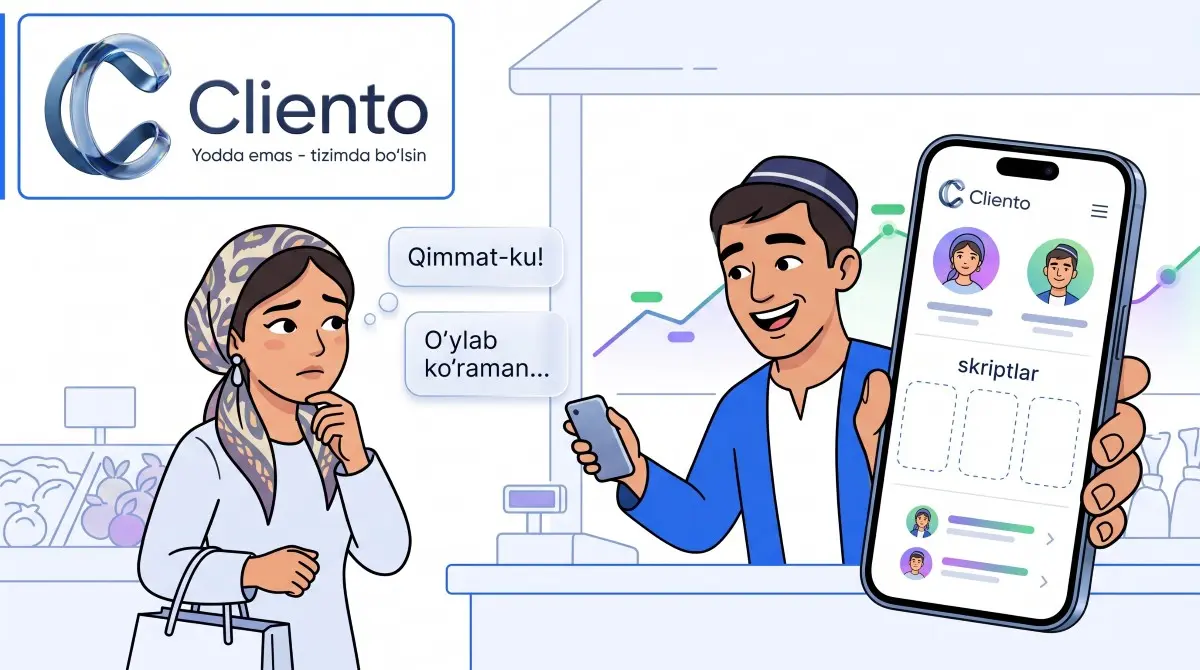
Handling objections: "too expensive", "I'll think about it", "later" — how to respond
Note: the people and figures in this article are a composite example based on typical situations in small businesses in Uzbekistan.
After building a 5-person sales team in his clothing business, Sherzod hit a new problem. The team worked leads well, knew the product, and spoke politely with customers. But everyone stopped at one point: when a customer said "too expensive" or "I'll think about it," the managers didn't know what to say. They'd reply "okay, think it over" and end the conversation.
Sherzod opened the CRM report and saw the picture clearly: the team talks with ~300 customers a month, and about 180 of them raise an objection. Of those 180, only 36 — 20% — turned into sales. The other 144 were lost right at the objection. And the interesting part: those customers hadn't said "no" — they had asked a question and got no answer.
The problem wasn't the product or the price — it was the missing skill of handling objections. In this article we'll cover the most common objections and professional answers: a 5-step method, ready scripts for "too expensive," "I'll think about it," "cheaper elsewhere," and "later," plus how to track objections in CRM.
An objection isn't rejection — it's a sign of interest
Many sales managers take an objection as personal rejection and back off. That's a costly mistake. In fact an objection means:
- The customer is thinking — they're seriously considering your offer
- The customer has an unresolved question — they're waiting for an answer
- The customer is giving you a chance — otherwise they'd just leave
- The objection is specific — so it can be solved
- An uninterested person doesn't object — they simply stop replying
So welcome the objection: the conversation isn't over. The sale starts right here. It's the most delicate funnel stage — see "Sales funnel optimization".
An objection isn't rejection — it's a question. An uninterested person doesn't object; they just quietly leave.
— Objection rule
The 5 steps of handling an objection
Any objection can be approached with one universal method. These 5 steps are the core skill Sherzod's team learned:
- Listen — don't interrupt, hear them out fully
- Acknowledge — "I understand, that's an important question." Don't argue
- Clarify — ask a question, find the real reason behind the objection
- Answer — with value, a fact, or an example. Short and clear
- Confirm and move on — "Does that answer your question?" then the next step
The most important step is the third. The stated objection often isn't the real reason. Someone saying "too expensive" may have a budget problem or may not see the value. Answer without asking and you solve the wrong problem.
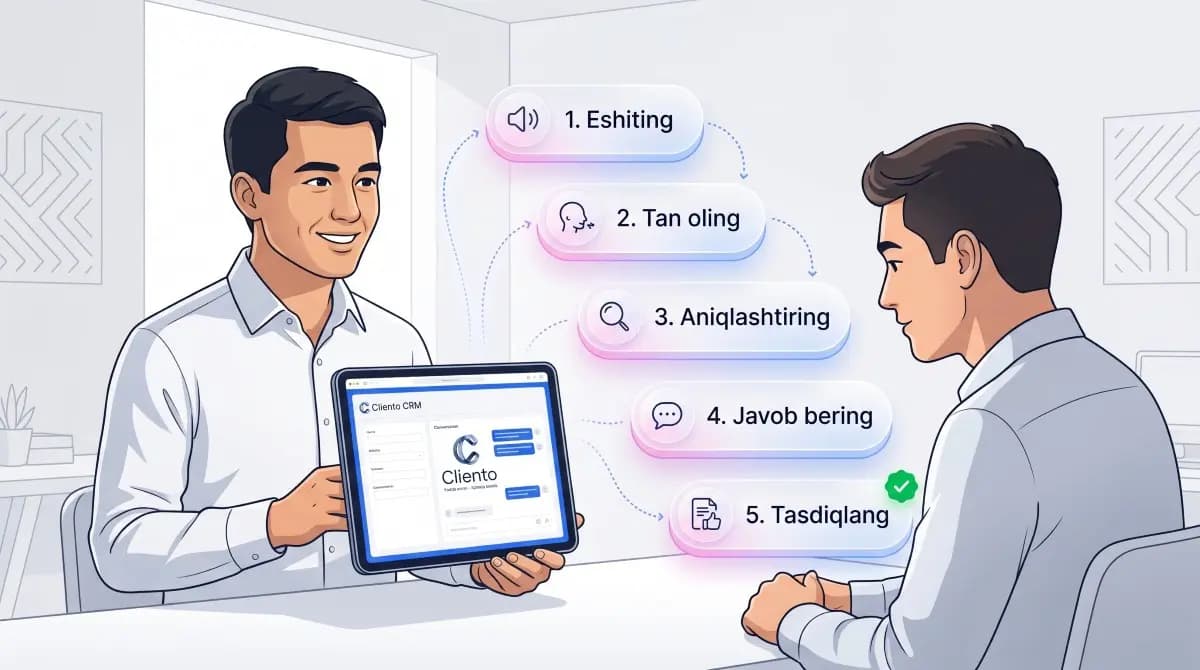
Many sellers rush to answer an objection. A professional asks a question first — because the stated objection often isn't the real reason.
— Clarification rule
The 4 most common objections and ready answers
Sherzod's team counted objections from CRM data: "too expensive" — ~40% of all objections, "I'll think about it" — ~30%, the rest relate to competitors and timing. Below are ready answers for each.
1. "Too expensive"
This objection is almost never about price — it's about value. The customer saw the price but didn't fully understand what they get for it. Clarify first:
- "I understand. By expensive — does it not fit your budget, or does the value not seem to match the price? Knowing that, I can suggest the right option"
- If it's budget: "If paying at once is heavy, we have installments"
- If it's value: "This saves you X every month — so it's not a cost, it's an investment"
- Compare: "Buy quality once and use it long, or buy cheap and replace it in six months?"
Important: don't offer a discount the moment you hear the objection. An instant discount tells the customer "so the price was inflated" and devalues your product.
"Too expensive" is a conversation about value, not price. When the customer sees the value, price stops being a problem.
— Price and value rule
2. "I'll think about it"
The most common objection and the biggest sales killer. Usually it's a hidden objection: the customer has an unspoken question. Your job is to surface it:
- "Of course, it's worth thinking over. Just one question: what exactly gives you doubt — the price, the timing, or something else?"
- "Usually at this stage customers think about X. Is that your question too?"
- If they don't answer: "Understood. What information would help you decide?"
- Always get a specific date: "Would Thursday work for a call?"
"I'll think about it" without a date is a nearly lost customer. Set a date and record it in CRM as a follow-up. More — "Customer follow-up: a repeat-contact system".
"I'll think about it" without a date is a polite "no." Set a specific date, or the customer will be lost.
— Specific date rule
3. "It's cheaper elsewhere"
The biggest mistake here is entering a price-cutting race. A sale won by cutting price is a sale without profit. The right approach:
- "Yes, prices differ in the market. Tell me — what's included in that offer?"
- Show the difference: warranty, quality, delivery time, service and support
- "Our price is different because it includes X, Y, and Z"
- "If you buy cheap and then have to redo it, the total cost is higher"
If a customer is only chasing price and value doesn't interest them — they're not your customer. Letting them go is also a right decision: not every customer has to be yours.
4. "No time now" and "later"
This objection comes in two kinds: genuinely busy, or a polite refusal. Telling them apart is easy — offer a specific date:
- "I understand you're busy. Shall I give you the key point in 2 minutes, or call at a better time?"
- "Would Tuesday at 15:00 work?" — offer a specific time
- If they say "later": "Understood. When is better to come back — in a week or a month?"
- Record the date in CRM as a reminder immediately
A customer who names a date is still a live lead. One who doesn't is probably refusing politely — but don't delete them entirely: move them to a long-term list.
Record objections in CRM
The fastest way to improve objection handling is to measure it. In CRM, each lost lead gets a reason: no budget, competitor, not interested, wrong timing. What this gives you:
- You see which objection kills the most sales
- You learn which manager is weak on which objection
- A team script is prepared for the most frequent objection
- Whether the script works is verified by numbers
- Lost leads are kept for a future win-back campaign
It was this report that showed Sherzod that "too expensive" caused 40% of all losses — and the team tackled it first. Ready answer templates — in "Sales scripts and templates".
If you don't record objections, you can't fix them. Only numbers show which objection is killing the most sales.
— Measurement rule
Sherzod's results
- Sales closed after an objection: 20% → 45%
- About 45 extra sales a month (from the same 180 objecting customers)
- Losses on the "too expensive" objection: 40% → 18%
- "I'll think about it" without a date nearly disappeared — each gets a follow-up
- Training new managers got faster — ready scripts exist
- Discounts are given less often — the team learned to sell on value
My team used to give up the moment they heard an objection. Now they wait for it — because they know the sale starts right there. Neither the product nor the price changed; we simply learned how to answer.
— Sherzod, clothing business owner
4 mistakes in handling objections
- Arguing — "no, you misunderstood" puts the customer on the defensive
- Giving a discount instantly — it devalues you, and future customers expect discounts too
- Answering without asking — you solve the wrong problem
- Giving up after the first objection — most sales happen after it
These mistakes tie into other common sales management problems — see "8 sales management mistakes".
How to start
- For a week, write down every objection your team hears
- Pick the 3-4 most frequent
- Write a script for each using the 5-step method
- Practice as a team — role-play before facing a real customer
- Turn on lost-reason tracking in Cliento CRM — register at crmcha.uz in 2 minutes
- Compare the numbers after a month — where you improved
On training the team and building skills — "Employee motivation and building a sales team".
Frequently asked questions
Should I answer an objection immediately?
No. First listen, acknowledge, and ask a clarifying question. The stated objection often isn't the real reason.
Should I give a discount for "too expensive"?
Not right away. First explain the value and find out whether it's a budget or a value problem. Installments are often better than a discount — they don't devalue your product.
What to do with "I'll think about it"?
Surface the hidden question: ask "what exactly gives you doubt?" And always get a specific date, recording it in CRM as a follow-up.
How many times should I address an objection?
Don't push more than 2-3 times in one conversation. But continue with follow-up afterwards: most sales happen after several contacts.
How do I track objections?
In CRM, set a reason for each lost lead. After a month the report shows exactly which objection kills the most sales.
Must every objection be overcome?
No. If a customer only wants the lowest price and value doesn't interest them, they're not your customer. Spend your time on the right ones.
Conclusion
An objection isn't the end of a sale — it's the start. "Too expensive," "I'll think about it," "cheaper elsewhere," "later" — these aren't rejections but questions waiting for answers. A 5-step method, ready scripts, and tracking objections in CRM — these three things change a team completely.
Sherzod proved it: the same product, the same price, the same team — but sales after an objection went from 20% to 45%. The difference was learning how to answer. "Not in memory — in the system": let your scripts and objection reasons live in the system too.
The first step — try Cliento CRM free at crmcha.uz in 2 minutes and start tracking objection reasons.