
Employee motivation and building a sales team — Uzbekistan experience
Note: the people and figures in this article are a composite example based on typical situations in small businesses in Uzbekistan.
Sherzod grew his clothing business 10x in 6 months, then hit a new problem: with 2 sales managers, that volume is unmanageable. He hired 8 people in 3 months — 5 quit, 2 underperformed, only 1 stayed. Lost 50 million UZS. Then he understood: the problem wasn't the people — it was his approach. Hiring, motivation, KPIs, compensation — all set up wrong.
This story is familiar to thousands of businesses in Uzbekistan. Hard to find, harder to keep. But solvable — with the right approach.
6 realities of team building in Uzbekistan
- Good sales manager — 5-15M UZS/month — but with results, it's cheap
- 60-70% of new hires quit in the first 3 months — global statistic
- Salary isn't the only motivator — youth need growth and respect
- 1 hour of training saves 10 hours later
- Keeping a bad employee — biggest damage
- Best employees come via referral, not job ads
Biggest mistake — thinking "I can do it all myself." Biggest wisdom — understanding "I can find people who'll do it better than me."
— Leadership rule
Part I: 5 steps of proper hiring
- Position profile — know exactly who's needed (tasks, KPIs, experience, character)
- Referral channel — best source (2-3M bonus per referred hire)
- Fast screening — 3 stages (resume → 5 min call → 45 min interview)
- Test task — paid, 1 week, on real tasks
- Probation — 3 months, clear monthly KPIs
Part II: Motivation system
Salary is only the base. Real motivation rests on 4 pillars: purpose, autonomy, mastery, respect. Without them, even +50% salary won't keep them.
Sales manager compensation structure
- Fixed: 60% — 4M UZS/month
- Sales commission: 3% (at 30M sales = +900K)
- Conversion bonus 30%+: 500K
- Retention bonus 40%+: 500K
- Team bonus: 1M each when team plan met
- Annual bonus: best seller — 10M UZS trip
Non-monetary motivators
- "Employee of the month" — diploma, office photo
- Birthday and family date greetings
- Professional growth — courses, books, conferences
- Flexible schedule
- 2 weeks full vacation yearly
- Career growth opportunity
- Open communication — weekly meetings, 1:1s
Part III: Training
- Day 1: company, team, tools introduction (CRM, Telegram)
- Week 1: product, prices, competitors, FAQ
- Week 2: work with experienced colleague, observation
- Week 3: independent work with daily review
- Week 4: full independence, weekly evaluation
Weekly training: every Friday 1 hour — new products, cases, best practices. ROI: 5-person team applies the knowledge 50 times next week.
Part IV: KPIs and transparent management
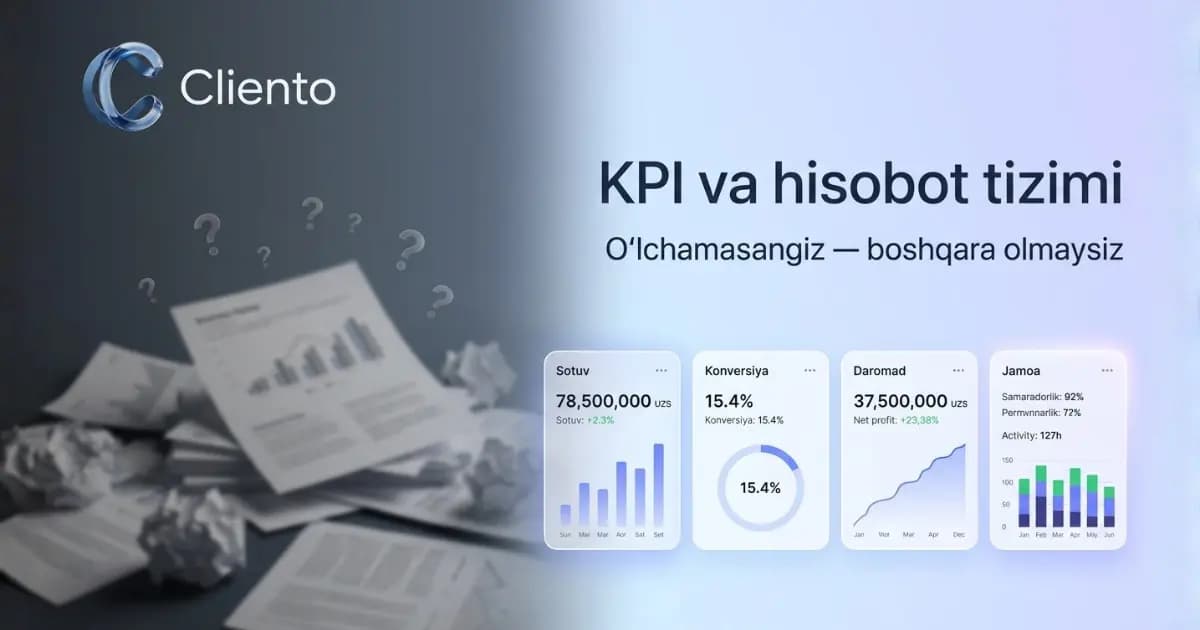
Transparency boosts motivation 2-3x. Detailed KPIs — in "Business KPI and reporting system". Key team principles:
- Each manager sees their KPIs in real time (CRM)
- Leaderboard — healthy competition
- Weekly 30-min team meetings
- Monthly 30-min 1:1 with each person
- Quarterly strategic meetings
Best leaders don't command — they show the way. Strong teams don't work under control — they work by results.
— Leadership principle
Part V: 6 biggest mistakes
- Rushing to hire — 6 months loss
- Only salary — ignoring 4 motivation pillars
- Keeping bad employee — damages team morale
- Micromanagement — employee can't work
- Forgetting praise — 80% positive, 20% correction
- Not being part of team — separate office, separate lunch
Sherzod's results in 6 months
- 5 managers (instead of 2) — all working 6+ months
- Turnover: 70% → 10%
- Average efficiency: 8 → 25 sales/month
- Onboarding: 3 months → 4 weeks
- Employee bonuses: 1.5-3M UZS/month
- Sherzod's working hours: 12 → 6
Before I had "workers" — worked for salary. Now I have "a team" — they work for the business. And working with them is my greatest joy.
— Sherzod, clothing business owner
CRM and team
Strong team impossible without CRM. Fairness, transparency, auto bonus calculation, retaining clients when staff leave, training materials. More — "Telegram business and automation" and "8 sales management mistakes".
Plan for beginners
- Step 1 (1 month): first manager with probation
- Step 2 (2-3 months): second hire, CRM implementation
- Step 3 (4-6 months): 3-4 managers, training, bonuses
- Step 4 (7-12 months): 5+ employees, department head
- Step 5 (1+ year): multiple departments, you as strategist
Frequently asked questions
When to hire first manager?
When you can't handle 30+ leads/month yourself. Usually at 30-50M UZS turnover.
Can you hire without experience?
Yes, with conditions: motivated, training plan ready, you have time to mentor.
How to calculate bonuses?
Bonuses — 30-50% of salary at good results. Commission 2-5% on sales. Simple formulas — otherwise no motivation.
When to fire a bad employee?
At 2 signs: KPI failure, team morale damage, training resistance. Fire fast — every month delayed = more damage.
How to keep the best?
4 things: value (money + words), give growth, personal relationship, stay ahead of market on salary.
Remote or office?
For sales — office is better. Energy exchange, culture. Hybrid (1-2 remote days) boosts motivation.
Conclusion
Strong team = right hiring + motivation + training + KPIs + compensation. With this, the team works itself. Sherzod grew from 80M to 250M UZS in 6 months. Try Cliento CRM free at crmcha.uz.
Also read
Business KPI and reporting system: what isn't measured can't be managed
12 essential KPIs, how to build a dashboard, reporting cadence, and biggest mistakes. Business without numbers is wandering in the dark.
8 sales management mistakes and how to fix them
8 key sales management mistakes and CRM solutions for each. Stop losing leads and customers — grow your sales 3x.
How to build and manage a sales pipeline: step-by-step guide
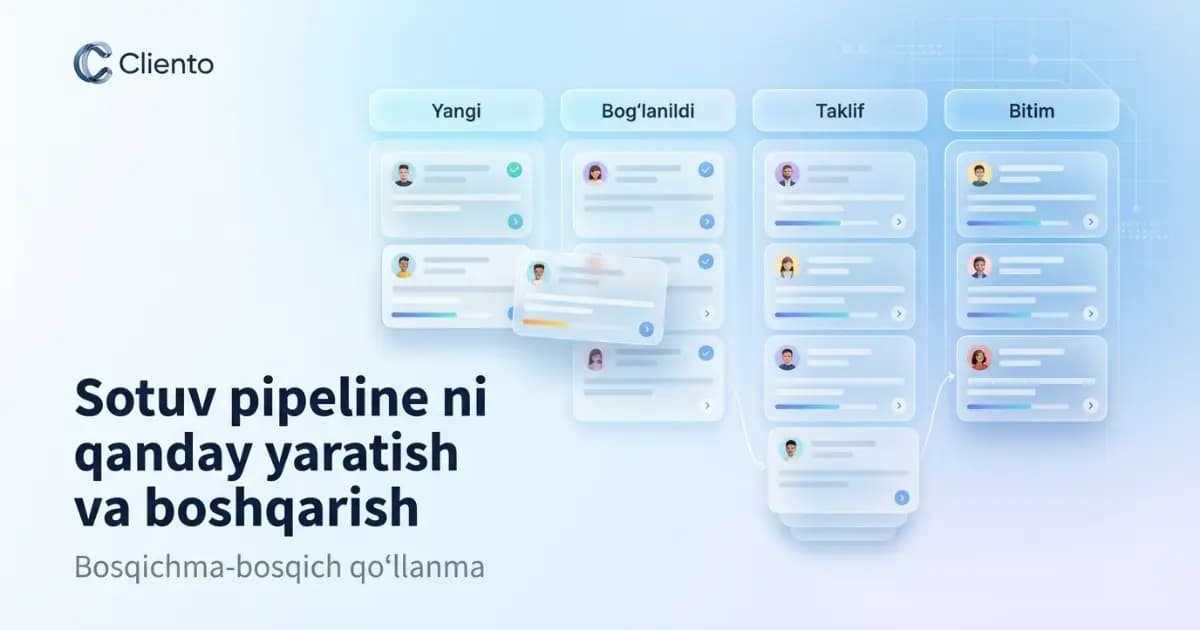
What is a sales pipeline, how to build and manage one — 6 stages, 5 common mistakes, and a practical guide to automating your pipeline with CRM.
Does CRM investment pay off? ROI calculation methods and real numbers
Every 1 UZS spent on CRM returns 8.71 UZS. Real calculations, ROI for a 5-person team, and the cost of not using CRM — all in numbers.