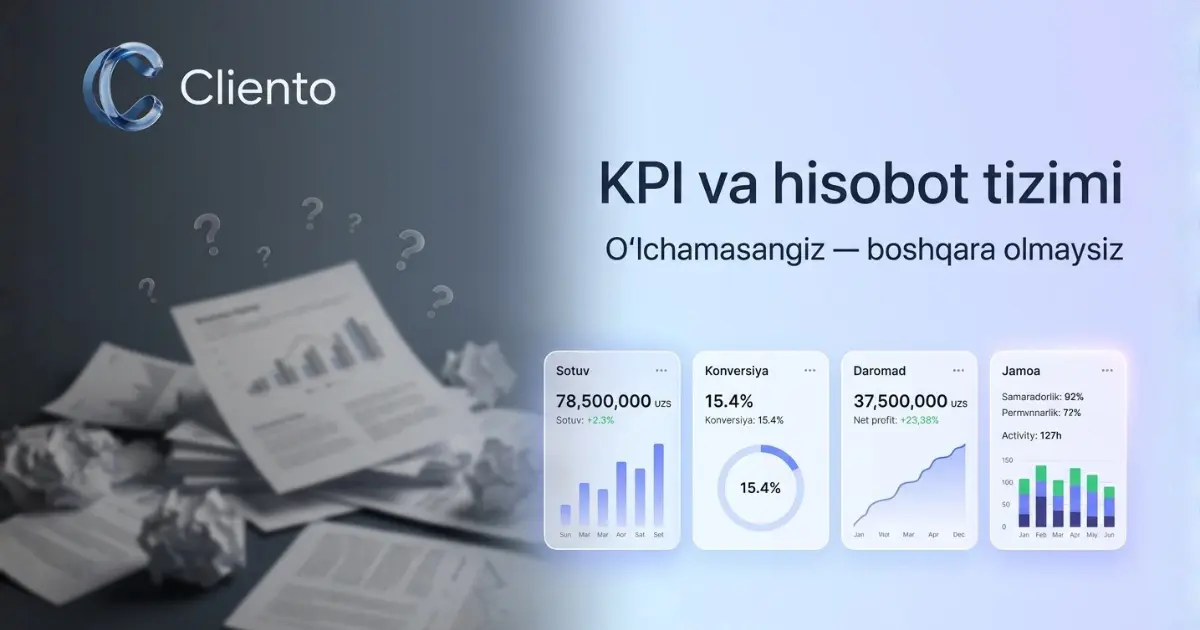
Business KPI and reporting system: what isn't measured can't be managed
Note: the people and figures in this article are a composite example based on typical situations in small businesses in Uzbekistan.
Akmal manages a restaurant in Tashkent. 25 staff, 800-1000 customers monthly. One day the accountant reported: "This month we lost 8 million UZS." Akmal was shocked — the restaurant was busy, Instagram active. "How is this possible?" Over the next 3 months he seriously studied his numbers for the first time. The truth emerged: food costs rose 12%, but menu prices weren't updated. Couriers wasted 30% of their time. Only 18% of new customers returned. Four months later, the business went from 8M UZS loss to 22M UZS net profit.
This story is familiar to thousands of businesses in Uzbekistan. Most are managed not by numbers, but by intuition: "Going well, I think." These aren't measurements — they're guesses. Running a business on guesses is like running in a dark room.
Why owners fear KPIs
- Think: "This is for big corporations"
- "Hard to calculate"
- "My business is still small, KPIs not needed"
- Reality: small business needs KPIs more than big
- Modern CRMs calculate everything automatically
Intuition is good, but only up to a point. Beyond that, it diverges from reality. Only numbers tell the truth.
— Management rule
12 essential KPIs for any business
Sales (4)
- Monthly Revenue — main indicator, but not the only one
- AOV (Average Order Value) — revenue ÷ number of deals
- Conversion Rate — buyers ÷ visitors × 100
- Sales Cycle Length — from first contact to closed deal
Customers (4)
- CAC (Customer Acquisition Cost) — operational costs ÷ new customers
- LTV (Customer Lifetime Value) — healthy business: LTV ≥ 3×CAC
- Retention Rate — % of returning customers
- NPS (Net Promoter Score) — would they recommend you
Operational (4)
- Net Profit Margin — % of revenue that becomes profit
- Operating Expense Ratio — operational costs / revenue
- Revenue per Employee — revenue ÷ employee count
- Inventory Turnover — for retail and restaurants
Building a dashboard: 4 rules
- No more than 10 numbers — only the most important
- Understandable at a glance — color coding
- Shows trend — current vs previous month
- For each KPI — one responsible person
Reporting cadence
- Daily (5 min) — revenue, leads, deals
- Weekly (30 min) — conversion, AOV, manager efficiency
- Monthly (2 hours) — net profit, CAC, LTV, retention
- Quarterly (1 day) — NPS, strategic indicators
5 biggest mistakes
- Too many KPIs at once — start with 5-7
- Only sales — ignoring profit and retention
- Excel instead of CRM — errors and outdated data
- Numbers exist, no actions — each KPI needs an action plan
- Hidden from team — transparency boosts motivation
A number doesn't work — a person works. But a number is a compass. Without a compass at sea, you can't find your way no matter how strong you are.
— Business navigation rule
CRM and KPI: why they work together
Cliento CRM automatically calculates: revenue, AOV, conversion, cycle length, manager efficiency, customer sources, new vs returning, pipeline. Nothing manual. Detailed ROI in "Does CRM investment pay off?". Sales control in "8 sales management mistakes".
Akmal's results in 4 months
- Net profit: -8M → +22M UZS
- Retention: 18% → 47%
- Food cost ratio: 38% → 27%
- Delivery efficiency: 70% → 92%
- Average check: 95K → 142K UZS
- Working hours: 14 → 9 hours daily
4-week implementation plan
- Week 1: Choose 5-7 KPIs, formulas, baseline, goals, owners
- Week 2: CRM, data import, dashboard, auto-reports
- Week 3: Daily analysis, weekly meetings, team discussion
- Week 4: Monthly analysis, KPI adjustment, quarterly strategy
Frequently asked questions
Do small businesses need KPIs?
Yes, especially. One mistake in small business can kill it. KPIs help spot problems early.
Need a programmer for KPIs?
No. Modern CRMs (Cliento) calculate automatically. Tableau and Power BI are for large corporations.
Can KPIs be tracked in Excel?
Technically yes, practically no. Manual entry, errors, not real-time, team can't see. CRM solves all 4 problems.
Most important KPI?
Depends on business. Universal 3: net profit, retention, manager efficiency. If these are good — usually rest is too.
Team resists KPIs?
Normal. Explain: KPIs aren't control, they're a tool. Transparency, discussion, bonuses for results, lead by example.
When are results visible?
Insights — 1 week. Decisions — 1 month. Visible changes — 3 months. Full transformation — 6-12 months.
Conclusion
What isn't measured can't be managed. 12 KPIs above — all important. Start with 5-7. Most importantly — not Excel, but CRM. Try Cliento CRM free at crmcha.uz.
Also read
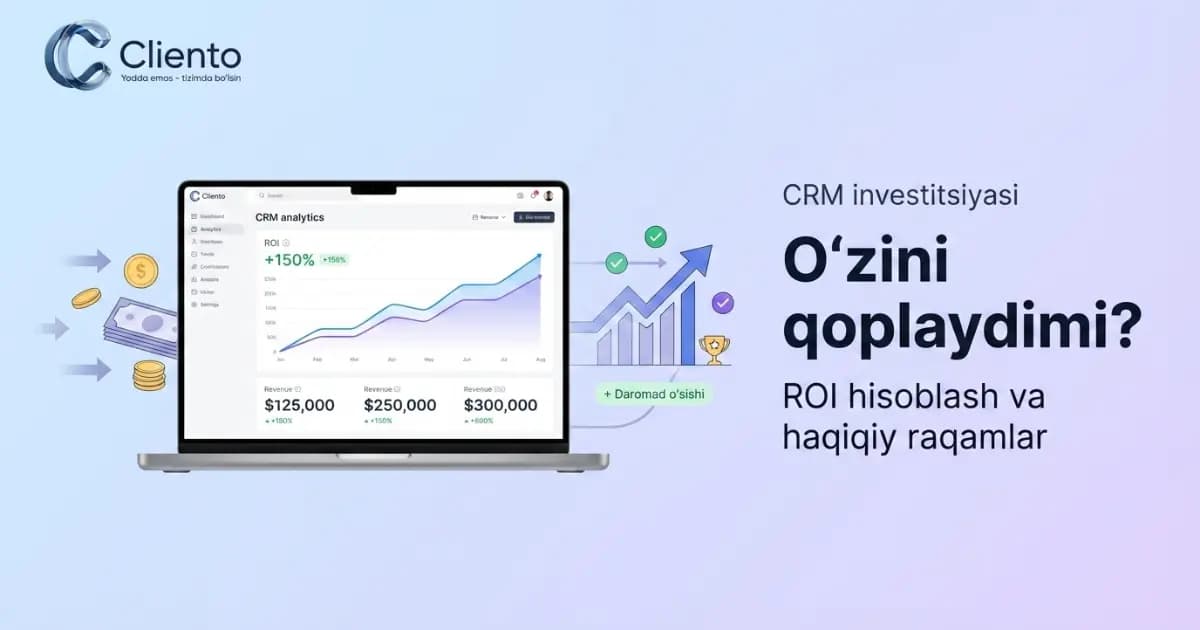
Does CRM investment pay off? ROI calculation methods and real numbers
Every 1 UZS spent on CRM returns 8.71 UZS. Real calculations, ROI for a 5-person team, and the cost of not using CRM — all in numbers.
8 sales management mistakes and how to fix them
8 key sales management mistakes and CRM solutions for each. Stop losing leads and customers — grow your sales 3x.
How to build and manage a sales pipeline: step-by-step guide
What is a sales pipeline, how to build and manage one — 6 stages, 5 common mistakes, and a practical guide to automating your pipeline with CRM.
Customer retention strategies: numbers and practical methods
How much losing a single customer costs, why customers leave, and 7 practical strategies to retain them. Building long-term relationships with CRM.