Sales funnel optimization: how to raise conversion at every stage
Note: the people and figures in this article are a composite example based on typical situations in small businesses in Uzbekistan.
After bringing order to his wholesale business with CRM, Olim noticed: lots of leads, but sales weren't growing. 200 inquiries a month, all in CRM, managers working — yet only 24 deals close by month's end. "Where do the other 176 leads go?"
The answer was inside the sales funnel. Every lead passes through stages: contact, qualification, proposal, negotiation, closing. And at each stage, some drop off. The problem: Olim didn't know which stage lost the most. He kept buying more ads — like pouring water into a leaky bucket.
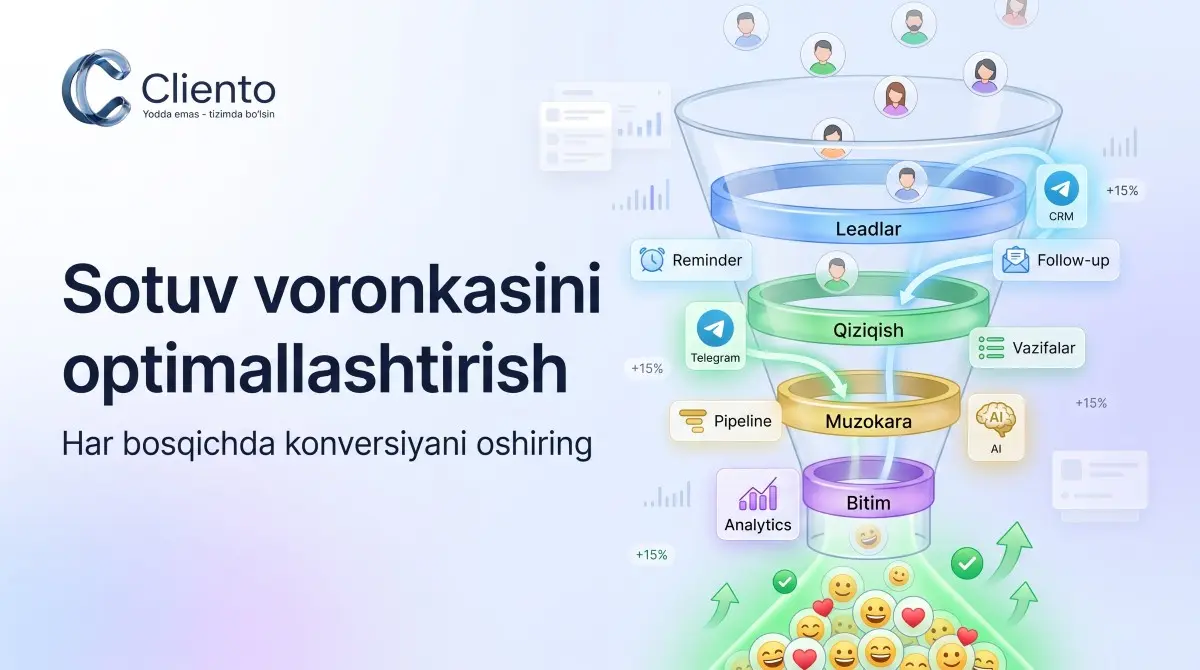
This is where funnel optimization works — the art of making more customers from the same leads. Using Olim's example, we'll cover funnel analysis, finding the bottleneck, raising conversion at each stage, and A/B tests. If you don't know what a funnel is, start with "Creating and managing a sales funnel"; this article is its sequel.
Why more leads isn't the answer
Many people's first thought: "few sales — need more leads." A costly mistake. At 10% conversion, 100 new leads give 10 sales; the other 90 are lost with the ad money. Raise conversion to 20% and the same 100 leads give 20 sales — with no extra ad spend.
This is the heart of the "30% formula" from "How to triple your business turnover in a year": improve each stage a little, and the result multiplies.
More leads is more water. But if the bucket leaks, no amount fills it. Fix the leak first.
— Funnel optimization rule
Step 1: Measure the funnel — where the customer drops off
Optimization starts with measurement. Here's Olim's funnel before optimization (per month):
- New leads: 200
- Contacted: 160 (lead→contact 80%)
- Qualified: 110 (contact→qualify 69%)
- Proposal sent: 80 (73%)
- Negotiation: 40 (proposal→negotiation 50%)
- Closed: 24 (negotiation→close 60%)
- Overall conversion: 24/200 = 12%
CRM builds this funnel automatically — the system knows each lead's stage.
An unmeasured funnel is a hole in a dark room. You don't see it, but your money leaks out right there.
— Measurement rule
Step 2: Find the bottleneck
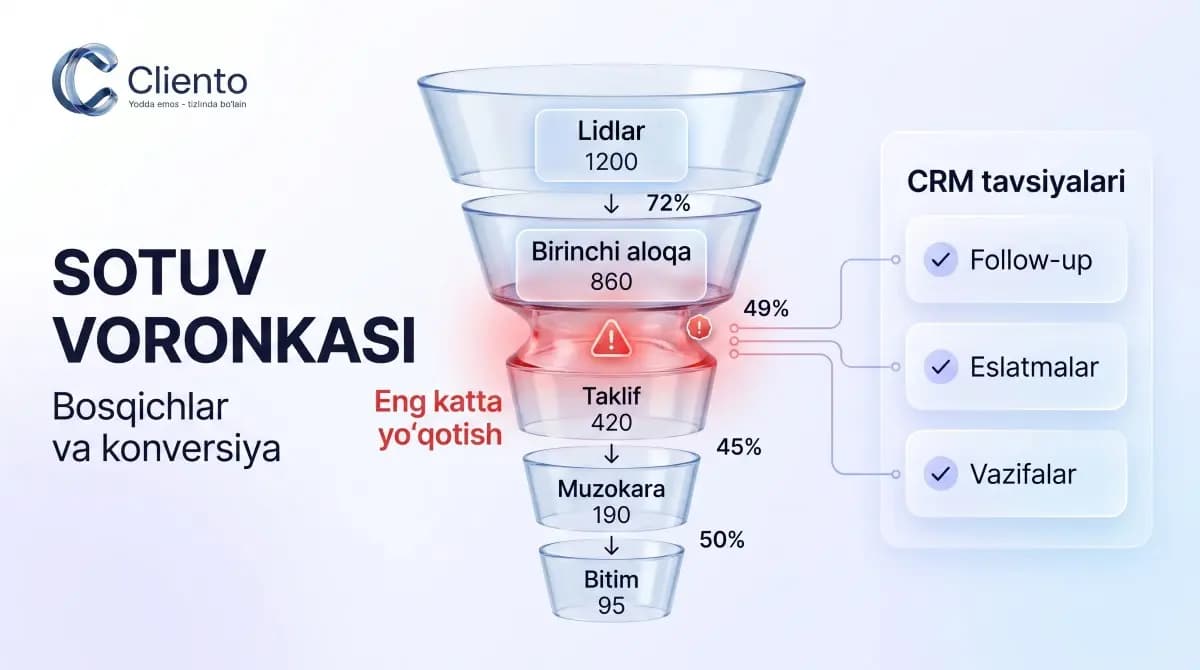
The bottleneck is the stage with the biggest loss. Look at each stage's conversion and find the lowest:
- Lead → Contact: 80% — good, but 40 leads went unanswered
- Contact → Qualify: 69% — normal
- Qualify → Proposal: 73% — good
- Proposal → Negotiation: 50% — the lowest! The bottleneck is here
- Negotiation → Close: 60% — average
The bottleneck is clear: after the proposal is sent, half the customers are lost. The reason was simple — managers sent the proposal and waited. There was no follow-up. The customer sees the proposal, gets busy, forgets — and no one reminds them.
Every stage matters, but the lowest-conversion stage holds your whole business. A chain is as strong as its weakest link.
— Bottleneck rule
Step 3: Raise conversion at each stage
Lead → Contact: speed decides
Reach out within 5 minutes of a lead arriving. A lead contacted in 5 minutes sells far better than one contacted in 30. CRM notifies the manager instantly.
Contact → Qualify: ask the right questions
Not every lead is a fit. Qualify quickly by budget, need, and decision timeline — so you don't waste time on unfit leads.
Proposal → Negotiation: follow-up is everything
This was Olim's bottleneck. The fix — systematic follow-up: auto reminder and contact after 1, 3, and 7 days. Many sales close on the 2nd-5th attempt. On automation — "10 sales automation methods".
Negotiation → Close: handle objections
At closing, customers object: "expensive," "we'll think," "later." Ready scripts help. Texts — in "Sales scripts and templates".
Many sellers stop at the first "no." But a deal often closes on the third or fourth attempt. The difference is a follow-up system.
— Closing rule
Step 4: A/B test — not a guess, an experiment
The biggest optimization mistake is relying on guesses. The right way — an A/B test: try two variants and let the numbers decide. What you can test:
- Proposal text
- Follow-up timing (1 or 3 days)
- Contact channel (call or Telegram)
- Price presentation (discount or installments)
Change only one thing at a time and gather enough data. See the result in CRM reports. More on measuring — "KPI and reporting system".
A guess is the most expensive advisor. An A/B test always tells the truth, because it rests on numbers.
— A/B test rule
Olim's results
Olim fixed the bottleneck (post-proposal follow-up), sped up first contact, and introduced objection scripts. A few months later, with the same 200 leads:
- Contacted: 160 → 180 (80% → 90%)
- Qualified: 110 → 130
- Proposal: 80 → 100
- Negotiation: 40 → 70 (50% → 70%)
- Closed: 24 → 44
- Overall conversion: 12% → 22%
The lead count didn't change — still 200. But sales nearly doubled, without a single extra sum on ads.
For years I chased more leads. The answer was inside my own leads — I just wasn't moving them the right way. Now I know every stage in numbers.
— Olim, wholesale business owner
How CRM helps optimize the funnel
- Visual funnel — each lead's stage is visible
- Stage conversion report — the bottleneck shows automatically
- Auto follow-up — no proposal left unanswered
- Instant lead notification — for the 5-minute rule
- Manager performance by stage
Cliento CRM simplifies this for Uzbekistan: visual funnel, conversion analysis, auto follow-up via Telegram, from 150K UZS/month. Payback — "CRM investment: ROI calculation".
Frequently asked questions
How long to optimize a funnel?
First analysis — a day. Fixing the bottleneck — 2-4 weeks. Full effect — 2-3 months. It's an ongoing process.
Does a small business need funnel optimization?
Yes. There, every lead is expensive, so raising conversion matters more. Even at 30-40 leads a month, analysis makes a big difference.
Which stage is usually weakest?
Often two: lead→contact (slow response) and proposal→close (no follow-up). But your bottleneck may differ — measure, don't guess.
How many leads for an A/B test?
At least 30-50 per variant. If leads are few, test longer. A conclusion from a small sample can be wrong.
Does optimization replace advertising?
No — it strengthens it. An optimized funnel makes more customers from each ad sum. Funnel first, ads second.
Can it be done without CRM?
Very hard. You can start in Excel, but manual counting is slow and error-prone. CRM does it automatically and in real time.
Conclusion
Funnel optimization is the cheapest, most effective way to grow. Instead of hunting new leads, make more customers from existing ones: measure the funnel, find the bottleneck, raise conversion, confirm with A/B tests.
Olim proved it: the same 200 leads, the same budget, but sales from 12% to 22% — nearly double. The difference was managing the funnel by numbers.
The first step — try Cliento CRM free at crmcha.uz in 2 minutes.
Also read
How to build and manage a sales pipeline: step-by-step guide
What is a sales pipeline, how to build and manage one — 6 stages, 5 common mistakes, and a practical guide to automating your pipeline with CRM.
Sales automation: 10 ways to stop doing manual work
70% of your salespeople's time goes to manual tasks. Automation eliminates this waste — 10 practical methods and 3x efficiency growth with CRM.
Sales scripts and templates: ready-made texts for every customer type
First contact, follow-up, objections, and closing — ready sales texts for every situation. Practical scripts for WhatsApp, Telegram, and calls.