
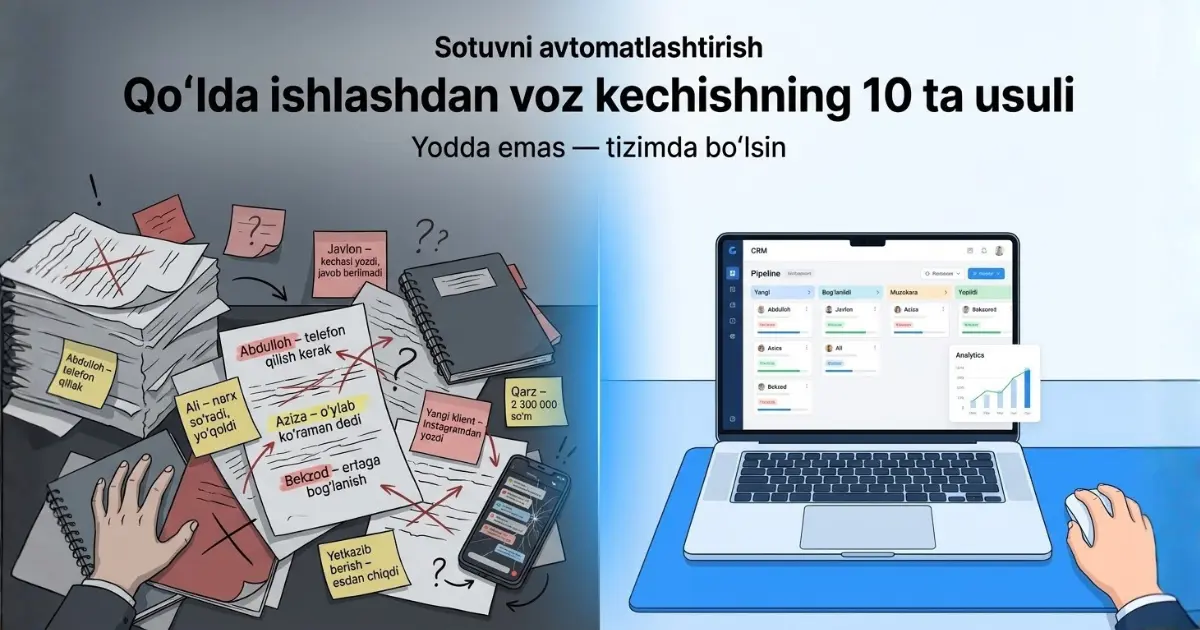
Sales automation: 10 ways to stop doing manual work
What do your salespeople do every day? Research shows that only 28-30% of work time goes to actual selling. The remaining 70% is spent on manual, repetitive tasks — data entry, file searching, report writing, note-taking. This is wasted time, and you may not even notice it. In this article, we'll explore how automation solves this problem and multiplies your team's efficiency.
How much is manual work costing your business
Imagine: you have 5 salespeople, and each spends 2.5 hours daily on manual tasks. That's 62.5 hours weekly, 250 hours monthly, 3000 hours yearly — and this is just a small team's loss. In money, at 50,000 UZS hourly rate, that's 150 million UZS wasted annually.
- 94% of SMB employees perform repetitive tasks daily
- Hidden costs from manual processes in a 20-person company reach 600 million UZS yearly
- Automation reduces data entry errors by 73%
- Automation ROI averages 240%, pays for itself in 6-9 months
Automation isn't about replacing employees — it's about letting them do real work. Let machines handle the repetitive, let people build relationships with customers.
— Modern business principle
10 processes ready for automation
- Follow-up reminders — instead of forgotten promises, CRM automatically reminds you of calls. Savings: 3-4 hours weekly
- Lead source tracking — which ads work? CRM shows exactly. Savings: 2 hours weekly
- New lead distribution — automatic assignment to salespeople by source or queue. Savings: 1-2 hours weekly
- Stage change notifications — deal status changes visible to the whole team instantly. Savings: 2 hours weekly
- Report generation — instead of manual Excel formulas, CRM gives a dashboard with one click. Savings: 3-5 hours weekly
- Customer data processing — automatic intake from forms and Telegram bot. Savings: 2-3 hours weekly
- Call and meeting logging — full interaction history in customer card. Savings: 2 hours weekly
- Payment deadline tracking — payment schedules with automatic notifications. Savings: 1-2 hours weekly
- Lead-to-customer conversion — one click, no manual copying. Savings: 1 hour weekly
- Team performance tracking — real metrics per salesperson. Savings: 2-3 hours weekly
Total result: time and money
These 10 methods save 20-30 hours weekly — nearly a full employee's work week. 80-120 hours monthly, 1000-1500 hours yearly. In money: 4-6 million UZS monthly savings, up to 50-75 million yearly. Meanwhile, CRM costs 150,000 – 300,000 UZS per month — a 15-40x return on investment.
4 automation mistakes to avoid
- Trying to automate everything at once — team gets confused. Start with the most painful problem
- Not preparing the team — resistance is inevitable. Explain the benefits, start with leadership
- Creating overly complex processes — simplicity wins. Start with 3-5 key automations
- Not measuring results — without numbers you can't evaluate effectiveness. Record metrics before and after
5 steps to start today
- Conduct an audit — one week recording all manual tasks for each employee
- Choose the most painful problem — usually follow-ups or reports
- Try a CRM — Cliento CRM offers free demo period
- Automate one process fully — observe for 2 weeks, collect feedback
- Move to the next — automate all 10 processes within 3-4 months
Conclusion
Manual work is your business's hidden cost. Every minute on data entry and reports is a minute stolen from sales. Automation stops these losses and returns your team to real work.
Cliento CRM provides all automation tools from this article — reminders, notifications, reports, lead management, payment tracking. Try it free at crmcha.uz.
Also read
AI and CRM: how artificial intelligence is transforming small business sales
AI doesn't replace salespeople — it makes them 40% more effective. The AI-CRM combo: lead scoring, auto-responses, forecasts, and personalization.
How to build and manage a sales pipeline: step-by-step guide
What is a sales pipeline, how to build and manage one — 6 stages, 5 common mistakes, and a practical guide to automating your pipeline with CRM.
What is CRM? A complete guide to customer relationship management for your business
What is a CRM system, how does it work, what benefits does it bring to business, and how to choose the right CRM for small businesses in Uzbekistan — explained in simple terms.