CRM for auto service and maintenance: client car history and reminders
Note: the people and figures in this article are a composite example based on typical situations in small businesses in Uzbekistan.
Rustam has run an auto service in Tashkent (Sergeli) for 12 years: 4 mechanics, 2 lifts, excellent quality. But the business stood still. Customers came, fixed their car, and left — often for good. Rustam couldn't recall what was done last time or when the oil was due. Of 130 cars a month, only 25% returned. Average check 380K UZS, turnover ~49M — unchanged for two years.
The problem wasn't skill — it was the lack of a system to manage the customer base. That's exactly where CRM transforms an auto service. Using Rustam's example, this article covers car history, maintenance reminders, parts, work orders, and the customer-return system.
5 invisible losses of an auto service
- No car history — what was done, which parts were installed
- No reminders for maintenance and oil changes
- Parts confusion — who a part was ordered for
- Verbal price deals → disputes
- One-time customers — no return system
An auto service loses a customer every day — but doesn't notice. A lost customer makes no noise; they simply go to another shop.
— Rule of hidden losses
1. Car history — a digital passport for every vehicle
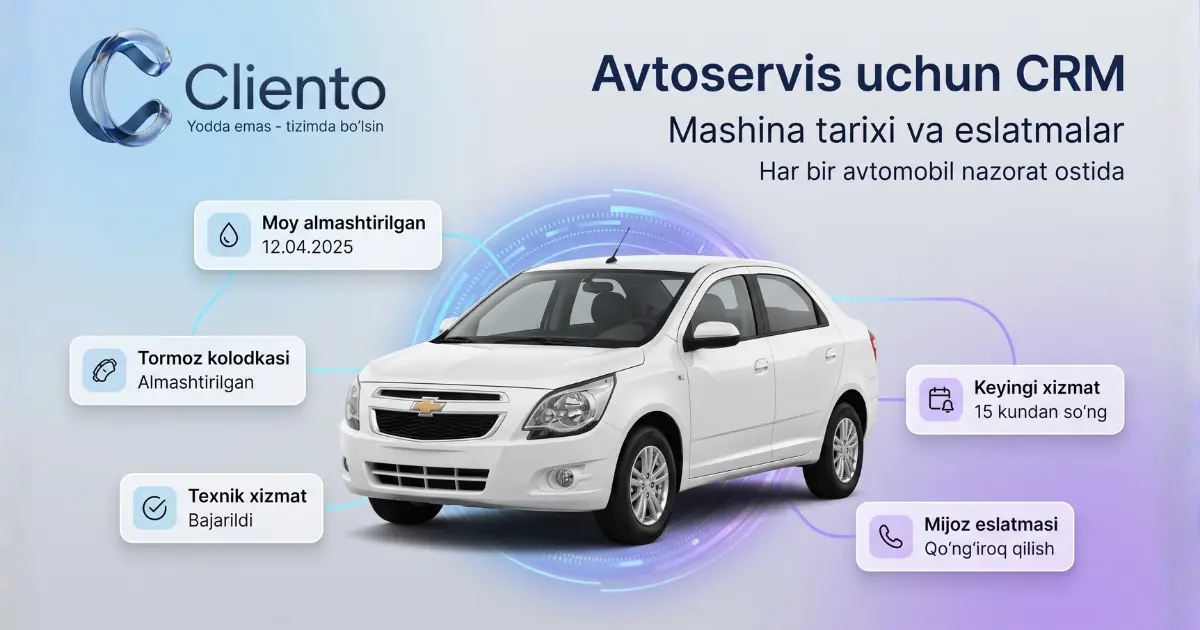
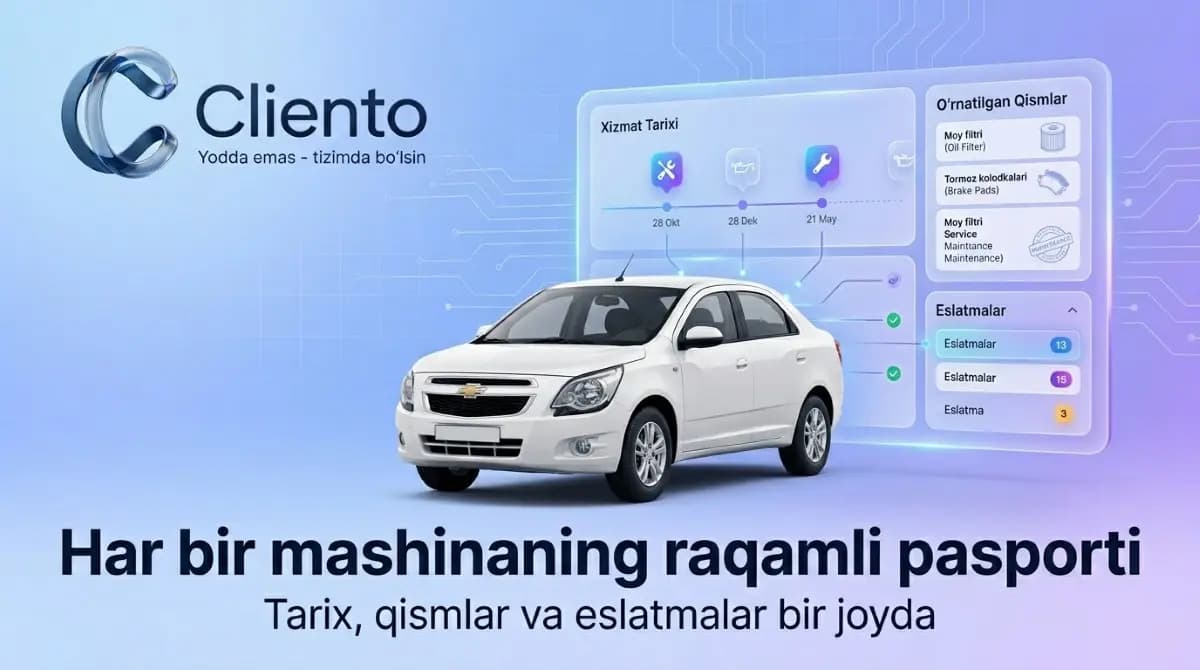
In CRM, each customer and car is a separate card. By license plate, Rustam instantly sees: model, year, mileage, full visit history, installed parts with warranty, work costs, and the next scheduled service. The customer now trusts him because he gives facts, not guesses. More on the customer base — "Building a customer base from scratch".
2. Maintenance reminders — the gold mine
Every car needs service after a certain time: oil, filters, brake pads, antifreeze. The customer forgets — but you can remind them. CRM sets the next service date and auto-sends a reminder via Telegram or a task to the manager:
- "Oil has reached 5000 km — time to change"
- "Brake pads changed 3 months ago — let's check them"
- "Winter is here — let's check antifreeze and battery"
This is what changed Rustam's business: whoever reminds first keeps the customer. See "10 sales automation methods" and "Telegram business and automation".
A customer forgetting an oil change is normal. Your job is to remind them. Whoever reminds first owns the customer.
— Customer return rule
3. Parts and orders
- Each part order is tied to a customer and car
- Part arrives → auto message to the customer
- Price and warranty saved — no disputes later
- Statistics on frequent parts — what to keep in stock
4. Work orders and price transparency
Most disputes are about price. Verbal deals destroy trust. In CRM a work order is created for each visit:
- Select customer and car — history opens automatically
- List of works with prices
- Required parts with prices
- Total calculated automatically — customer sees and confirms
- After the job — invoice and warranty document
A transparent price is not just honesty — it's marketing. A customer who understands what they pay for returns and recommends you.
— The economics of trust
5. Customer return system
All the profit of an auto service is in repeat customers. A repeat customer brings 3-4x more and needs no ad spend. CRM builds a return system:
- Auto reminders for maintenance and oil changes
- Holiday greetings and discounts
- Win back long-absent customers
- Bonuses for loyal customers
- Post-visit quality survey
Full strategy — "Customer retention strategies". Turning a one-time customer into a regular is an auto service's biggest source of growth.
An auto service's most valuable customer is the one you already won. To bring them back you don't need ads — just a reminder.
— Repeat revenue rule
Rustam's results after 6 months
- Repeat customers: 25% → 55% (almost 2x)
- Cars per month: 130 → 175
- Average check: 380K → 460K UZS
- Turnover: 49M → 80M UZS (almost 1.6x)
- ~40 customers a month return thanks to oil reminders alone
- Price disputes — nearly gone
I used to think customers return because I'm the best mechanic. Now I understand: quality is a duty; the return is ensured by the system.
— Rustam, auto service owner
What a CRM for auto service should have
- Customer and car card, search by license plate
- Maintenance reminders by date or mileage
- Parts and order management
- Work orders and price calculation
- Telegram integration
- Reports: revenue, % repeat, average check
Cliento CRM is built for Uzbekistan: Uzbek interface, full Telegram integration (bot and Mini App), local payments (Payme, Click, Uzum), from 150K UZS/month. See "How to choose a CRM for your business".
How to start
- Register at crmcha.uz in 2 minutes, free demo
- Import your base from notebook or Excel
- Create a car card for each customer
- Set up maintenance reminders
- Train mechanics via Telegram
- Analyze reports after a month
CRM payback — in "CRM investment: ROI calculation".
Frequently asked questions
Does a small auto service need CRM?
Yes — even more so, since every customer matters. A 2-3 mechanic shop grows fast through repeat customers when it keeps car history and sends reminders.
My mechanics can't use computers — is it hard?
Everything runs through Telegram — open a card, see a work order, mark it done in a couple of taps. No complex software to learn.
How do maintenance reminders work?
Set the next service date or mileage — the system reminds the customer or creates a task for the manager. You don't need to remember anything.
Is customer data safe?
Yes — each company's data is isolated, encrypted, and regularly backed up.
How much and when does it pay off?
From 150K UZS/month — cheaper than one work order. If even 3-4 customers return monthly, it pays off many times over.
Conclusion
An auto service's success depends not only on the mechanic but on the customer-return system. Car history, reminders, transparent work orders, and a return mechanism — all in one CRM. Rustam proved it in 6 months: same mechanics, same service, but turnover grew almost 1.6x. Cliento's motto says it all: "Not in memory — in the system." Try Cliento CRM free at crmcha.uz.