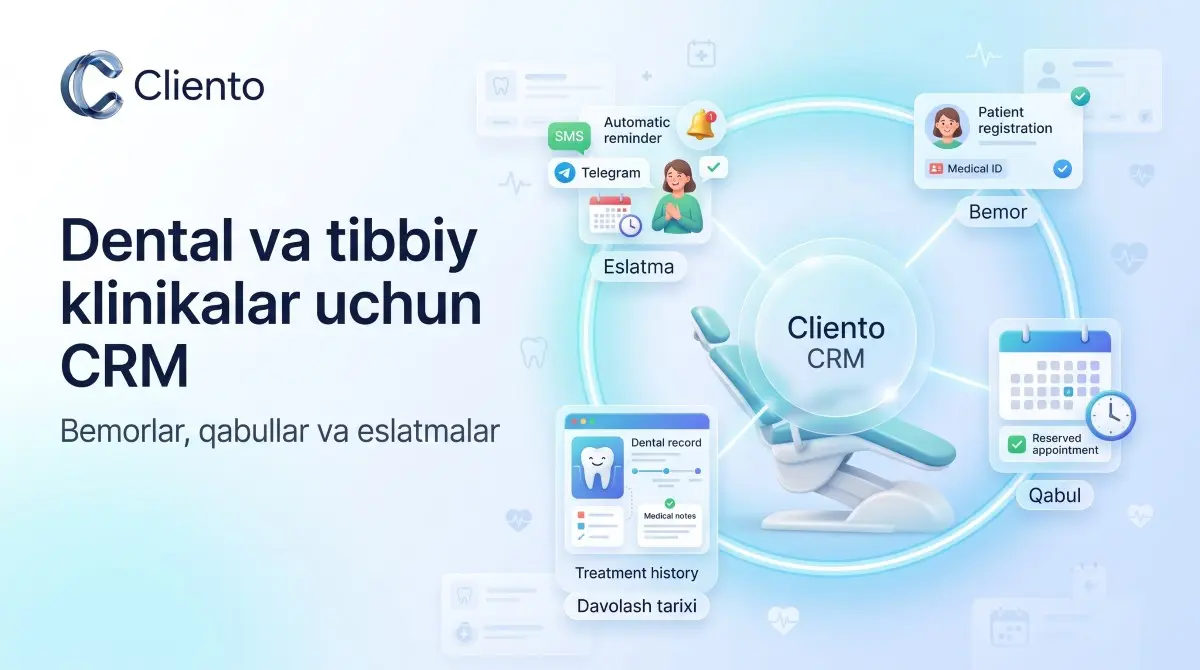
CRM for dental and medical clinics: patients, appointments, and reminders
Note: the people and figures in this article are a composite example based on typical situations in small businesses in Uzbekistan.
Kamola runs a dental clinic in Tashkent (Chilanzar): 3 experienced dentists, modern equipment, excellent treatment quality. But management was chaotic. Patient data lived in paper cards, appointments were taken by phone, and the schedule sat in a notebook on the wall. Sometimes two patients were booked for the same time; sometimes a dentist sat idle.
The biggest problem — patients didn't return. Much dental treatment is multi-stage: implants, orthodontics, prosthetics take months. Patients wouldn't come back after the first stage because no one reminded them. The preventive checkup — once every six months — was forgotten entirely. Of ~200 patients a month, only 30% returned, and 28% of those booked didn't show up.
Kamola realized: the problem wasn't the dentists' skill — it was the lack of a patient-management system. This is where CRM for dental and medical clinics works. Using Kamola's example, we'll cover the patient database, appointment scheduling, treatment history, automatic reminders, and confidentiality.
5 invisible problems of a clinic
- Patient history on paper — past treatment, allergies, x-rays in separate cards, hard to find
- Appointment schedule tangled — phone and notebook, two patients on one slot
- Many no-shows — the patient forgets, the dentist's time is wasted
- Multi-stage treatment abandoned — implant or orthodontic patients don't return
- No preventive checkups — the patient isn't called back after 6 months and goes elsewhere
A clinic's biggest revenue comes not from a new patient but from one who finished treatment and returns. What keeps them is a reminder.
— Patient return rule
1. Patient database and treatment history
In CRM, each patient is a separate card — their digital medical record. Kamola's dentists see the whole history on one screen: personal data and important notes (allergies, chronic conditions); visit history (when, which doctor, what was done); treatment plan (stages done and pending); payment history; the next scheduled visit. More on the base — "Building a customer base from scratch".
Knowing a patient's history isn't just convenience — it's safety. Correct treatment starts with complete information.
— Medical record rule
2. Appointment scheduling and the no-show problem
The schedule is the heart of clinic work. CRM brings order: each doctor's schedule, free and busy slots, the visit's purpose. Most importantly, it solves no-show:
- Every appointment in the system — date, time, doctor, treatment type
- Auto-reminder to the patient a day before via Telegram
- Impossible to book two patients for one slot
- Frequent no-shows are flagged
- A freed slot is quickly offered to the next patient
A reminder before the appointment sharply reduces no-shows. The booking-and-reminder principle is detailed in "CRM for beauty salons and SPA: booking and client history"; it works the same for a clinic.
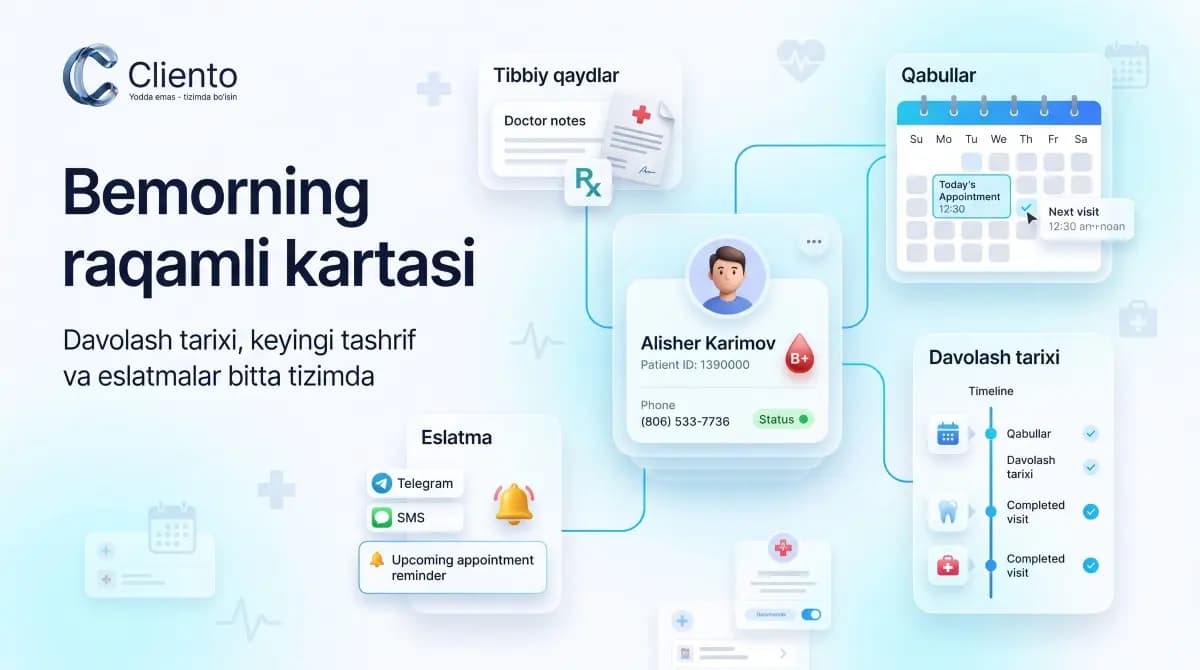
A no-show is an idle doctor and lost revenue. One reminder brings back both the time and the income.
— Appointment management rule
3. Automatic reminders — next visit and prevention
This is a clinic CRM's strongest feature. Almost every patient must return: the next treatment stage, prevention, cleaning. The patient forgets — CRM reminds:
- "It's time for the next stage of your treatment"
- "You had a checkup 6 months ago — time for a review"
- "It's been 3 months since your implant — please come for a control visit"
This is what changed Kamola's clinic. Patients used to forget prevention and, when a problem worsened, went to another clinic. Now Kamola's clinic reminds first. On automation — "Telegram business and automation" and "10 sales automation methods".
A patient forgetting the next visit is normal. The clinic's job is to remind them. Whoever reminds first, the patient trusts with their health.
— Preventive reminder rule
4. Finishing multi-stage treatment
Much dental and medical treatment is long: implants, orthodontics, prosthetics take months and several visits. If the patient stops — bad for health and lost revenue for the clinic. CRM manages the treatment plan:
- A treatment plan is entered stage by stage for each patient
- After each stage — an auto reminder and booking for the next
- A list of unfinished treatments — the administrator tracks them
- A payment schedule — with installments for expensive treatment
As a result, the patient finishes treatment and the clinic completes what it started. That's both a medical outcome and steady revenue.
5. Confidentiality and data security
Medical data is the most sensitive. CRM here is safer than paper cards:
- Each clinic's data is isolated — no outsider sees it
- Data is encrypted, passwords protected
- Role-based access — each staff member sees only their own
- Regular backups — paper is lost and burns; a digital base is preserved
Paper is lost, burns, falls into the wrong hands. Digital, protected data is always in place and under control.
— Data security rule
Kamola's results
- No-show: 28% → 7%
- Repeat patients: 30% → 58%
- Unfinished treatments: sharply fewer
- Returned for prevention: ~35 a month
- Monthly revenue: 55M → 90M UZS (almost 1.6x)
- Doctor idle time: noticeably less
I used to think patients return because the dentists treat well. Now I understand: quality is a duty; the return is ensured by the system.
— Kamola, dental clinic director
What a clinic CRM should have
- Patient card — full treatment history and important notes
- Appointment schedule by doctor, with no-show control
- Auto reminders for visits and prevention
- Treatment plan — stage-by-stage tracking
- Confidentiality — isolation, encryption, role-based access
- Telegram integration
Cliento CRM is built for Uzbekistan: Uzbek interface, full Telegram integration, data isolation and security, local payments (Payme, Click, Uzum), from 150K UZS/month. See "How to choose a CRM for your business".
How to start
- Register at crmcha.uz in 2 minutes, free demo
- Enter your patient base — from cards gradually or from Excel
- Set up a schedule for each doctor
- Enable auto reminders — before visits and for prevention
- Enter stage-by-stage treatment plans
- Analyze reports after a month — no-show and % repeat
CRM payback — in "CRM investment: ROI calculation".
Frequently asked questions
Does a small clinic need CRM?
Yes. Every patient matters there. A 2-3 doctor clinic grows through repeat patients when it keeps history and sends reminders.
Is patient data safe?
Yes. Each clinic's data is isolated, encrypted, and visible only to authorized staff — safer than paper cards.
Will doctors and the administrator learn the program?
Cliento is simple. Booking an appointment, opening a card, sending a reminder — a couple of taps, including via Telegram.
How to reduce no-shows?
With an auto-reminder a day before the appointment. The patient often just forgets — a reminder brings them back.
How do preventive reminders work?
Set the next checkup date (e.g., in 6 months) — the system reminds the patient or creates a task for the administrator.
How much and does it pay off?
From 150K UZS/month. One returned patient or a couple of avoided no-shows pays for the system many times over.
Conclusion
A dental and medical clinic's success depends not only on the doctors' skill but on the patient-management and return system. Database, schedule, treatment history, auto reminders, and data confidentiality — all in one CRM. Kamola proved it: the same doctors, the same equipment, but monthly revenue grew almost 1.6x, and patients began finishing their treatment.
Most importantly — now no patient is forgotten and no treatment is left half-done. Cliento's motto says it: "Not in memory — in the system."
The first step — try Cliento CRM free at crmcha.uz in 2 minutes.
Also read
CRM for beauty salons and SPAs: booking, client history, and loyalty
Manage your salon or SPA systematically. Bookings, client history, staff scheduling, and loyalty program — all in one system via Telegram.
Building a customer base from scratch: where to find your first 100 customers
The first 100 customers are the hardest. Warm network, referrals, organic content, and paid channels — a step-by-step plan from zero to your first customer.
Telegram business and automation: a complete guide for Uzbekistan
27 million Telegram users — your customers. Run your business 24/7 with Telegram bot and CRM integration, no app installation needed.