
Improving Customer Service: How to Turn Complaints into Opportunities
Note: the people and figures in this article are a composite example based on typical situations in small businesses in Uzbekistan.
Malika runs a beauty salon in Tashkent. Once she set up an online booking system, her no-show problem was solved and the business grew — we covered that in "CRM for beauty salons and spas". Last year Malika opened a second branch: now she has 2 salons, 9 stylists and more than 900 active clients. But along with growth came a new, invisible problem.
One day one of Malika's longest-standing clients left a negative review on Instagram: her hair color came out wrong, the administrator promised that "the stylist will call you back," but nobody ever called. This client had been coming to the salon for 5 years and had brought 4 friends with her. None of them came back. Worst of all, Malika only learned about the complaint 3 weeks later — from the Instagram review.
Malika did the math: the two salons receive about 35 complaints a month — by phone, on Telegram, on Instagram and in person. Not a single one was recorded anywhere. Only 20% of complaining clients ever came back, and around 25 clients quietly left every month. In this article we use Malika's story to show how to receive and resolve complaints, win clients back, measure customer satisfaction and track all of it in a CRM.
5 hidden costs of poor customer service
Many business owners consider their service "good" — because they rarely hear complaints. But an unheard complaint is not the same as no complaint. Poor customer service hurts a business like this:
- Silent churn — most unhappy customers don't complain, they simply go elsewhere
- Lost complaints — a verbal complaint is forgotten as soon as the administrator changes
- Negative reviews — an unanswered complaint on Instagram and Telegram reaches hundreds of people
- Referrals stop — an unhappy customer leaves and takes their friends along
- The same mistake repeats — without recorded complaints, the root cause is never found
A customer who complains still trusts you. A customer who leaves silently has already made up their mind.
— Customer service rule
1. A complaint is a gift: why complaining customers are valuable
When a customer complains, they spend time on you and give you a chance to fix the mistake. A customer who leaves silently gives you no such chance. So treat a complaint not as an attack to defend against, but as free advice:
- A complaint shows a weak spot in your business — from the outside, through the customer's eyes
- A well-resolved complaint makes a customer even more loyal than before
- One complaint may carry the voice of dozens of customers who left silently
- Complaint analysis is the cheapest source for improving service quality
- A fast reply to a complaint is the simplest way to stand out from competitors
The first rule Malika taught her team: when you hear a complaint, nobody argues and nobody makes excuses. For other ways to keep customers, read "Customer retention strategies".
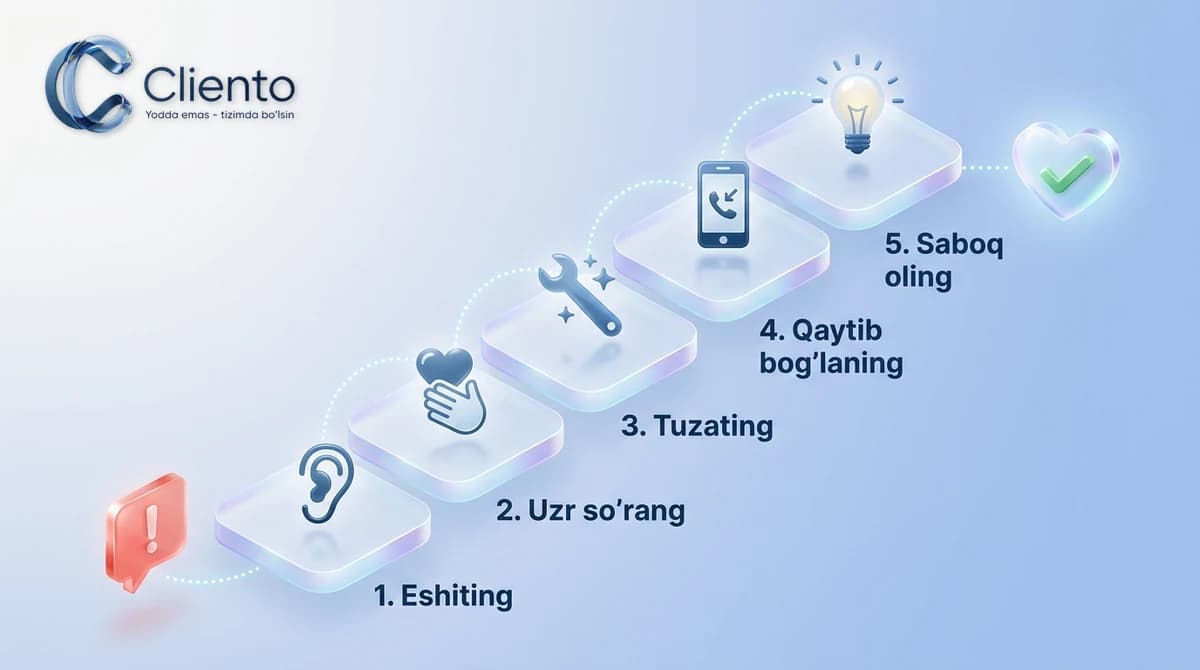
2. The 5 steps of handling a complaint
Resolving a complaint shouldn't be improvisation. Malika introduced one procedure for every administrator and stylist in both salons:
- Listen — let the customer finish, don't interrupt and don't argue
- Apologize — regardless of who is at fault, sincerely apologize for the inconvenience
- Fix it — offer a concrete solution: a redo, a discount or a refund
- Follow up — call the customer 3–7 days later and check that everything is fine
- Learn from it — record the cause and change the process so it doesn't happen again
These steps resemble objection handling — the difference is that an objection comes before the sale, while a complaint comes after it. We covered objections in detail in "Handling objections".
A customer may forget their complaint, but they will never forget how you treated them.
— Service quality rule
3. Every complaint is a CRM task: owner, deadline, history
Malika's main mistake was that complaints stayed verbal. The administrator would say "the stylist will call," and the stylist didn't even know about it. Now every complaint is opened in the CRM as a task linked to the client card:
- Who complained — the client card with visit history and past complaints
- What happened — a short description: which service, which stylist, which branch
- Complaint type — waiting, quality, attitude, price or hygiene
- Owner — who resolves the complaint, one specific person
- Deadline and priority — when it must be resolved and how serious it is
- Outcome — what was done and whether the customer was satisfied
If a task goes overdue, the CRM notifies the owner, and Malika sees all open complaints from both salons in a single list. Once a complaint is resolved, a follow-up reminder is set — we described this process in "Customer follow-up system".
A verbal promise is not a promise. A task with an owner and a deadline is a real promise.
— Accountability rule
4. Response speed: how fast to answer a complaint
With complaints, speed matters as much as the solution itself. The longer a customer waits, the angrier they get. Malika set clear response times for her salons:
- First reply — within 2 hours: "We've received your complaint and are working on it"
- Serious complaint (quality, health) — a manager gets in touch the same day
- Full resolution — within 24–48 hours
- Reply to a public review on Instagram and Telegram — within 1 hour, then move to private messages
- Follow-up — 3–7 days after the complaint is resolved
Telegram notifications make these deadlines much easier to keep: as soon as a complaint task is opened, the owner sees it on their phone. Read more about automation through Telegram in "Telegram for business and automation".
Reply to a complaint in 2 hours — you solve the problem. Reply in 2 days — you lose the customer.
— Response speed rule
5. Finding recurring problems — complaint analysis
Once complaints were being recorded in the system, Malika saw the real picture for the first time. Sorting 3 months of complaints by type revealed:
- 40% — long waiting times (mostly on Saturdays and Sundays)
- 25% — hair coloring quality, most of them tied to one new stylist
- 15% — the administrator's attitude
- 12% — the final price differed from the agreed one
- 8% — other reasons
These numbers showed Malika exactly what to do: weekend booking slots were redistributed, the new stylist spent 2 extra weeks training alongside an experienced one, and prices are now agreed with the client in writing before the service starts. As a result, the most frequent complaint — waiting — fell from 14 to 4 a month.
One complaint is an accident. Five identical complaints in a month is a hole in the system.
— Complaint analysis rule
6. Measuring customer satisfaction: NPS and a short survey
Complaints are the voice of unhappy customers only. To see the full picture, you need to measure customer satisfaction regularly. The simplest way is NPS (Net Promoter Score):
- The customer is asked one question: "From 0 to 10, how likely are you to recommend us to a friend?"
- 9–10 — promoters: they advertise you themselves
- 7–8 — passives: satisfied, but could easily switch elsewhere
- 0–6 — detractors: unhappy, with a high risk of leaving
- NPS = % of promoters minus % of detractors
After every visit, Malika's administrators send the client a short survey on Telegram and record the answer in the client card. Anyone who scores 0–6 gets a call from the administrator the same day — dissatisfaction is caught before it turns into a complaint. To track NPS alongside other metrics, read "KPIs and reporting in business".
Malika's results
Six months after introducing the complaint system, here's what changed across both of Malika's salons:
- Recorded complaints: almost 0 → 100% (35 a month on average)
- First reply to a complaint: 2–3 days → within 2 hours
- Customers returning after a complaint: 20% → 68%
- Customers leaving silently each month: 25 → 9
- Most frequent complaint (waiting): 14 → 4 a month
- NPS: 21 → 54
- Monthly revenue from repeat visits: +18%
I used to get upset when I heard a complaint. Now I read every single one — because each one tells me where to fix my business.
— Malika, beauty salon owner
What a CRM for customer service should include
A regular chat or notebook isn't enough to handle complaints systematically. A CRM should include:
- Client card — all visits, purchases and past complaints in one place
- Tasks — with an owner, deadline and priority
- Reminders — for following up after a complaint is resolved
- Notes and activity history — who did what, and when
- Custom fields — for complaint type, NPS score and other metrics
- Telegram notifications — instant alerts about new and overdue tasks
- Reports — an overview of clients, tasks and team performance
Cliento has all of this: tasks and reminders, full history and notes in the client card, custom fields and 14 types of Telegram notifications. Quiet hours (22:00–08:00) keep staff undisturbed at night, and daily and weekly reports arrive automatically. Pricing starts at 150,000 UZS per month. For CRM selection criteria, read "How to choose a CRM system for your business".
How to get started — practical steps
Building a complaint system doesn't require a big budget or a separate department. Malika started with these same 7 steps:
- Collect complaints from every channel in one place — phone, Instagram, Telegram and in person
- Define complaint types — 5–6 categories are enough: waiting, quality, attitude, price, other
- Write down response times — first reply within 2 hours, full resolution within 48 hours
- Open every complaint as a CRM task and assign a specific owner
- Once a complaint is resolved, set a follow-up reminder for 3–7 days later
- Review the complaint report every month and fix the 3 most frequent causes
- Run an NPS survey every quarter and compare the result with the previous one
Good customer service isn't an expense, it's an investment: winning a customer back costs far less than acquiring a new one. Calculate how well this investment pays off with the formula in "CRM investment: calculating ROI".
Frequently asked questions
How fast should you respond to a complaint?
The first reply should come within 2 hours, even if the solution isn't ready yet: let the customer know the complaint has been received. Full resolution usually takes 24–48 hours. Serious complaints involving health or safety should be resolved the same day.
Should you apologize even if the customer is wrong?
Yes, but in the right sense. You don't have to admit fault — you apologize for the inconvenience the customer experienced, then calmly explain the facts. A business that wins the argument usually loses the customer.
How should you respond to a negative review on Instagram?
Quickly, calmly and openly: apologize, acknowledge the problem and move the conversation to private messages. Don't delete the review and don't argue — other customers judge you by exactly how you respond.
How often should you measure NPS?
For a small business, a general survey once a quarter plus one short question after each service is enough. What matters is recording the result and comparing it over time. An NPS above 30 is generally considered good, and above 50 excellent.
Should you offer compensation for a complaint?
Not always. In most cases a fast reply, a sincere apology and fixing the problem are enough. If the service quality really was poor, offer a free redo or a discount on the next visit. Record compensation in the CRM so you keep costs under control.
Does a small business need a complaint system?
Small businesses need it most. A large company won't notice losing a few customers, but for a small business every regular customer is a noticeable share of monthly revenue. You don't need a complex system: opening each complaint as a CRM task and assigning an owner is already a good start.
Conclusion
A complaint is the cheapest and most honest advice a business can get. Once Malika understood this, she stopped hiding complaints and started collecting them: she recorded each one in the system, assigned an owner, replied quickly and analyzed the causes. As a result, the share of customers returning after a complaint rose from 20% to 68%, and NPS climbed from 21 to 54.
The secret of customer service isn't complicated: listen, apologize, fix it, follow up and learn from it. It just has to live in a system, not in one person's memory. "Not in memory — in the system."
Start systemizing your customer service today. Sign up at crmcha.uz in 2 minutes and try Cliento in free demo mode — from the day you open your first complaint as a CRM task, no unhappy customer will leave silently again.