

Managing a Seasonal Business: Making the Most of High and Low Seasons
Note: the people and figures in this article are a composite example based on typical situations in small businesses in Uzbekistan.
Madina runs a travel agency in Tashkent. After adopting a CRM, the agency grew fast — we covered that in "CRM for travel agencies". Today 6 sales managers work in her Tashkent office and the new branch in Samarkand. But as the business grew, one problem became impossible to ignore: the agency's income rises and falls through the year like a mountain road.
In July the agency sells 320 million UZS worth of tours, the managers can't keep up with calls, and 30% of inquiries don't get a timely reply. In February, revenue drops to 70 million UZS — while rent, 6 salaries and advertising stay the same every month, around 60 million UZS. Last winter Madina had to borrow money to pay salaries. And nobody could say exactly where the money earned in summer had gone.
Madina realized the problem wasn't the season — it was failing to manage it. You can't change the season, but you can prepare for it. In this article we use Madina's story to show how to manage a seasonal business: get the most out of high season, make low season profitable, plan cash flow, and base all of it on CRM data.
5 hidden risks of a seasonal business
Tourism, education, clothing, wedding services — in Uzbekistan a great many businesses are seasonal. Seasonality itself isn't dangerous; facing it without a plan is:
- Lost leads in high season — lots of inquiries, nobody to answer, and the customer goes elsewhere
- Cash shortage in low season — fixed costs don't shrink, while revenue drops 3–4 times
- Summer profit "melting away" — high-season money is spent without a plan, nothing is left for winter
- Team burnout — overload in summer, idle time in winter
- Losing touch with customers — once the season ends, the customer is forgotten and picks another agency next year
You can't change the season. But whether you're ready for it is your choice.
— Seasonal business rule
1. See the season in numbers — a seasonal map
The first step is to rely on numbers, not gut feeling. Madina gathered 2 years of CRM data by month and built the agency's "seasonal map":
- Leads per month — when customers start asking
- Sales and revenue per month — when the money comes in
- Time from inquiry to sale — in travel it's 3–8 weeks
- Demand by destination — Turkey in summer, Dubai and Egypt in winter
- Monthly fixed costs — in which months revenue doesn't cover them
The map revealed something surprising: inquiries for summer tours start not in May but in February–March — customers plan their summer in winter. So the "low season" is really the start of the next high season. For tracking metrics regularly, read "KPIs and reporting in business".
2. Prepare for high season in advance
Preparing once high season has started is too late. Madina now starts preparing for summer in February:
- Early booking campaign — a discount and installment payments for anyone who books by the end of March
- Ready answer templates — prices and terms for the 10 most requested destinations
- Lead distribution rules — every new inquiry is assigned to a specific manager immediately
- Temporary helpers — 1–2 extra managers for June–August are trained in advance
- Supplier agreements — hotel and flight quotas are reserved ahead of time
Automating routine work also saves the team in high season: reminders, notifications and ready templates free managers' time for what matters most — selling. We covered this in "Sales automation: 10 ways".
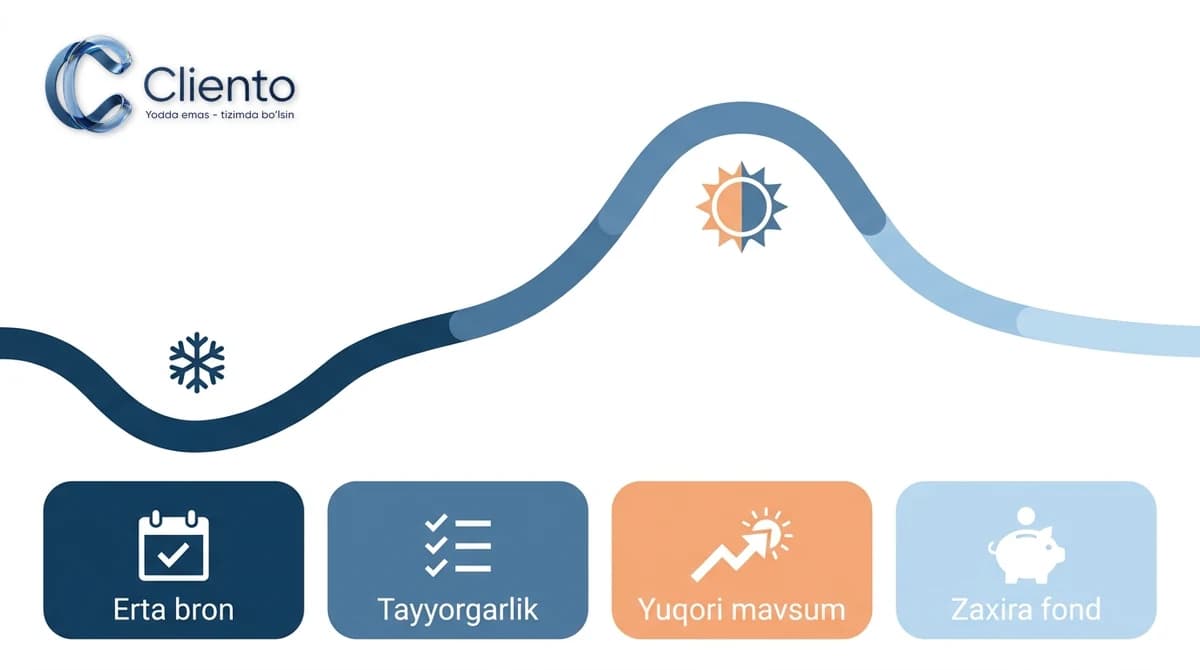
High-season tours are actually sold in winter — summer is just when the money comes in.
— Early booking rule
3. Maximum profit in high season: don't lose a single lead
The main risk of high season isn't a lack of customers — it's having too many. Last July the agency received about 600 inquiries, and 180 of them got a reply after more than an hour or no reply at all. Now Madina's team works by these rules:
- Every inquiry is recorded in the CRM as a lead — whether it came from Telegram, Instagram or a phone call
- First reply within 15 minutes, even if the exact price isn't ready yet
- Every customer who says "I'll think about it" gets a 1–2 day reminder
- Extra services are offered — insurance, excursions, transfers
- The list of open leads is reviewed at the end of each day
For handling leads quickly and correctly, read "Turning leads into customers". Complaints also rise in high season — we covered how to manage them in "Improving customer service".
Every unanswered inquiry in high season is a customer gifted to a competitor.
— Fast reply rule
4. Low season isn't downtime — it's sowing time
February used to be an "empty month" for Madina's team. Now it's one of the most important months of the year. In low season the agency focuses on:
- Winter destinations — Dubai, Egypt, the Chimgan mountains and Umrah pilgrimage
- Corporate tours — team trips and holiday events for companies
- Reactivating the customer base — personal offers to those who traveled last year
- Early booking sales — summer tours sold with a prepayment
- Team training — new destinations, sales scripts and working in the CRM
- Staff vacations — scheduled for winter so everyone is on hand in summer
Reactivating the base delivered the biggest result: the CRM held more than 1,400 former customers, each with a record of where, when and on what budget they traveled. Managers called 20 of them every day with a personal offer. To make repeat contact systematic, read "Customer follow-up system".
The customer you call in low season is the first to remember you in high season.
— Low season rule
5. Cash flow planning: earn in summer, live through winter
The most dangerous mistake in a seasonal business is treating high-season revenue as profit. In fact, part of that money belongs to the coming winter. To keep income stable, Madina introduced simple rules:
- Reserve fund — 15% of every high-season payment goes to a separate account
- Reserve target — at least 3 months of fixed costs (about 180 million UZS)
- Prepayment — a deposit is taken for early bookings, the rest is paid in installments
- 3-month cash flow plan — every month, expected income and expenses for the next 3 months are calculated
- Variable costs — the advertising budget goes up or down with the season
A CRM helps a lot with cash flow planning: deals in the sales pipeline and their payment schedules show how much money will come in over the next months. Madina now sees on one screen who has paid a deposit, who still owes a balance and when it's due.
Summer revenue isn't profit yet. Profit is what's left after a winter without loans.
— Cash flow rule
6. Seasonality isn't just for tourism
Madina's experience fits almost any industry — only the seasonal months differ:
- Education centers — enrollment peaks in September and January, fewer students in summer
- Clothing — sales jump when the season changes and before holidays
- Restaurants and banquet halls — busy in the autumn wedding season and holidays, quieter in winter
- Fitness clubs — many new members in January and spring, attendance drops in summer
- Auto services — demand for maintenance rises before winter and in spring
For example, education centers fill the summer dip with intensive courses and early enrollment for September — we wrote about it in "CRM for education centers". Whatever your industry, start by building your own seasonal map.
Madina's results
Twelve months after introducing the seasonal plan, here's what changed at Madina's agency:
- Revenue in the weakest month (February): 70M → 125M UZS
- Revenue in the strongest month (July): 320M → 360M UZS
- Gap between the best and worst month: 4.6x → 2.9x
- Unanswered inquiries in high season: 30% → 6%
- Share of early bookings for summer tours: 8% → 35%
- Repeat customers: 20% → 36%
- Reserve fund: 0 → 3 months of fixed costs; no winter loan was needed
I used to dread the coming of winter. Now I know: winter is when you sell next summer.
— Madina, travel agency director
What a CRM for a seasonal business should include
Managing a season takes data — and it needs to be in one place. For a seasonal business, a CRM should include:
- Lead database — with the source and date of every inquiry
- Sales pipeline — which stage each deal is at
- Deal payments — deposit, balance and due dates
- Tasks and reminders — so no customer is forgotten in high season
- Customer history — who traveled where, when, and how much they paid
- Telegram notifications — instant alerts about new leads and overdue tasks
- Reports and export — for month-by-month comparison and the seasonal map
Cliento has all of this: leads and a sales pipeline, deal payments, tasks and reminders, full history in the client card, 14 types of Telegram notifications, daily and weekly reports, and data export to Excel. Pricing starts at 150,000 UZS per month. For CRM selection criteria, read "How to choose a CRM system for your business".
How to get started — practical steps
You don't need an analytics department to build a seasonal plan. Madina started with these same 7 steps:
- Gather leads, sales and revenue for the last 12–24 months, broken down by month
- Build a seasonal map — mark high, medium and low months
- Calculate fixed costs and find the months where revenue doesn't cover them
- Introduce a reserve fund rule — 10–15% of high-season revenue
- Launch an early booking or pre-order campaign 2–3 months before high season
- Plan for low season — base reactivation, new services, training
- Update the cash flow plan for the next 3 months every month
To see how well the time spent on seasonal planning and the cost of a CRM pay off, use the formula in "CRM investment: calculating ROI".
Frequently asked questions
How do I know if my business is seasonal?
Put your monthly revenue for the last 12 months side by side. If your best month is more than 1.5 times your worst and this repeats every year, your business is seasonal. For an accurate picture, compare at least 2 years of data.
Should I stop advertising in low season?
Don't stop completely — scale down and change focus. In low season, aim advertising at early booking, winter offers and bringing back existing customers. A business that switches advertising off entirely starts high season from zero.
How much should go into a reserve fund?
The general rule is at least 3 months of fixed costs: rent, salaries and mandatory payments. The easiest way to build it is to set aside 10–15% of every high-season payment. If seasonality is strong, raise the reserve to 4–6 months of costs.
Should I hire extra staff for high season?
Yes, if a noticeable share of inquiries goes unanswered. But temporary staff should be hired and trained 3–4 weeks before the season starts. A newcomer hired mid-season often brings more mistakes than help.
How can I keep staff busy in low season?
Low season is the best time for base reactivation, training, developing new services and vacations. Give staff a clear plan: for example, call 20 former customers every day and record the outcome in the CRM.
How does a CRM help a seasonal business?
A CRM collects data for the seasonal map, makes sure no lead is lost in high season, and lets you work your former customer base again in low season. Deal payments show the cash flow for the coming months.
Conclusion
Success in a seasonal business comes from preparing for the season, not waiting for it. Madina saw the season in numbers, prepared for summer during winter, filled low season with early bookings and base reactivation, and built a reserve fund. As a result, revenue in the weakest month rose from 70 to 125 million UZS, and winter loans became a thing of the past.
You can't change the season, but managing it is in your hands. For that, data has to live in a system, not in one person's memory. "Not in memory — in the system."
Start preparing for the next season today. Sign up at crmcha.uz in 2 minutes and try Cliento in free demo mode — collecting data for your first seasonal map starts that same day.